
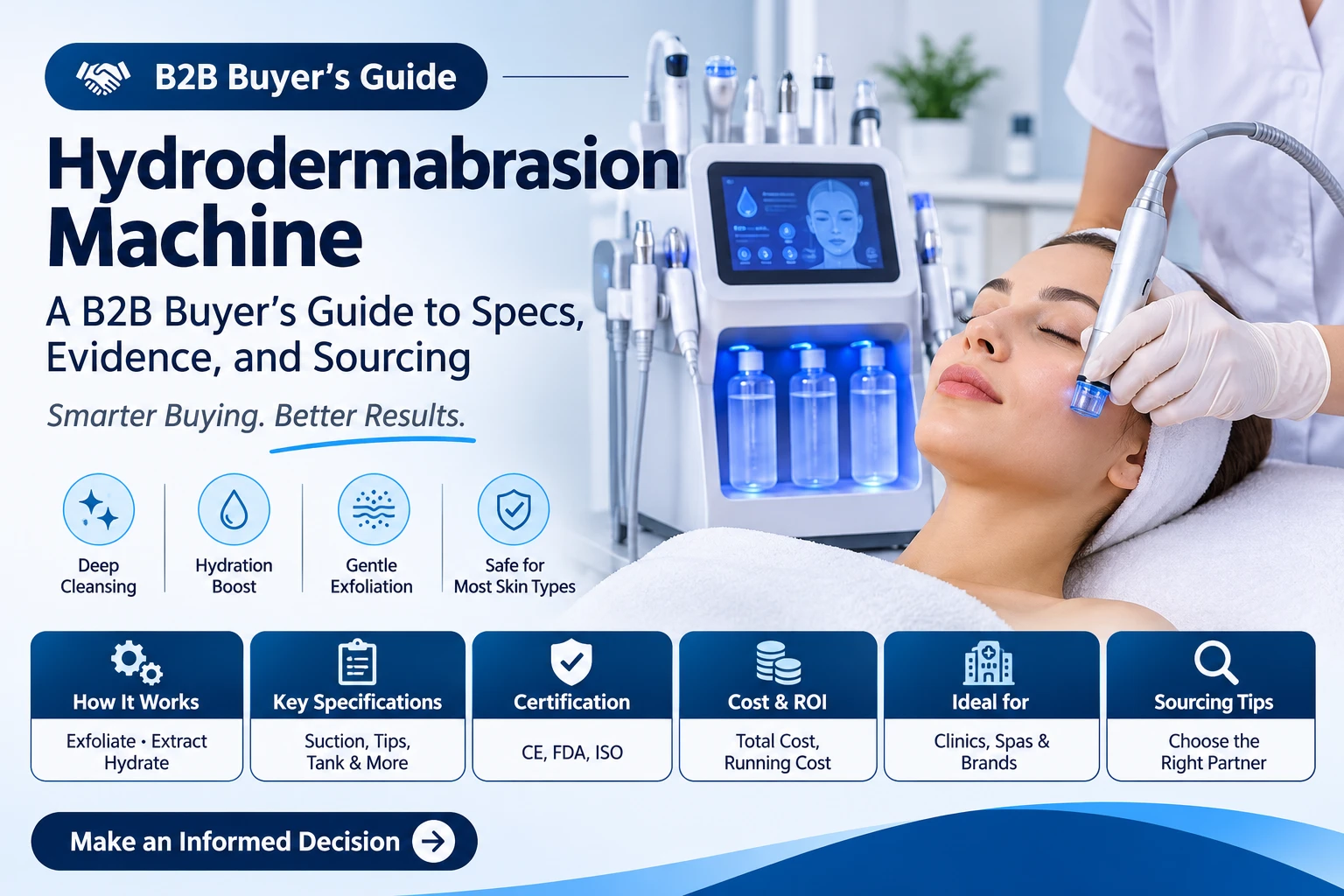
Hydrodermabrasion Machine: A B2B Buyer’s Guide to Specs, Evidence, and Sourcing
Hydrodermabrasion is one of the most requested facial services in professional aesthetics, and it is often the first machine a clinic buys. The treatment is familiar to clients, comfortable for most skin types, and easy to position as a gateway service. That popularity also means the market is full of machines that look alike in photos but differ in suction performance, handpiece quality, consumables, certification, and support.
This guide is written for B2B buyers. It explains how a hydrodermabrasion machine works, what the research does and does not show, which specifications to compare, and how to source and position the equipment honestly.
What Is a Hydrodermabrasion Machine?
A hydrodermabrasion machine is a facial treatment device that combines gentle exfoliation, vacuum suction, and the delivery of liquid serums in one handpiece. It is used in clinics, spas, and salons for cleansing, exfoliation, and hydration, and it is often described as a wet alternative to traditional microdermabrasion, which uses abrasive crystals.
You will see several names for this equipment: hydrodermabrasion, hydradermabrasion, hydro facial machine, and similar labels. Treat these as search terms for the same family of devices.
Our hydrodermabrasion machine category collects our related guides and device profiles.
How a Hydrodermabrasion Machine Works
1. Exfoliation
A handpiece tip passes over the skin and loosens dead skin cells and surface debris. Tip design, pattern, and material affect how gentle or active the exfoliation feels, and different tips suit different skin conditions.
2. Suction and Extraction
Vacuum suction lifts away loosened debris and sebum from the skin surface and pores. Adjustable suction strength matters, since sensitive areas and different skin types need different settings.
3. Serum Delivery
Liquid solutions are delivered through the handpiece during treatment. Machines vary in how many solutions they hold, how those are routed, and how the flow is controlled.
4. Optional Add-On Functions
Many machines add modules such as LED light therapy, RF (radiofrequency), ultrasonic skin scrubbing, oxygen spray, or cold hammer. Each added module raises the price and should be evaluated and certified on its own.
What the Research Shows
Buyers should know that the evidence base for hydrodermabrasion is smaller than for some other aesthetic technologies. A study using line-field confocal optical coherence tomography noted that clinical studies validating the efficacy of hydradermabrasion with non-invasive assessment of skin changes are scarce, and it reported microscopic features of skin rejuvenation in a small group of eight volunteers. Other published work is often small, short, and sometimes linked to a particular brand.
Types of Hydrodermabrasion Machines
Single-Function Units
These focus on exfoliation, suction, and serum delivery. They are the simplest and lowest-cost option and suit clinics that want a reliable core service.
Multifunction Hydro Facial Systems
These combine hydrodermabrasion with LED, RF, ultrasonic, oxygen, or other modules in one cabinet or tower. They give a wider menu and a stronger retail story, but each module must be well engineered. Our guide to choosing a professional facial machine explains how to judge multifunction machines.
Portable and Compact Units
These suit mobile practitioners and small treatment rooms. Compare suction power, tank capacity, and handpiece durability, because compact units can compromise on these.
Comparison at a Glance
| Type | Main strength | Main risk | Best for |
|---|---|---|---|
| Single-function | Simplicity and lower cost | Narrower menu | New clinics and entry-level services |
| Multifunction | Wider menu in one machine | Weakly engineered modules | Clinics with established demand |
| Portable | Small footprint | Lower suction and capacity | Mobile practitioners |
Specifications That Matter
Request these in writing when comparing manufacturer quotes:
- Suction System: Ask about the vacuum pump rating, adjustable suction range, and safety limits. Consistent suction is central to the treatment.
- Handpiece Tips and Consumables: Ask how many tip types are included, how long they last, and what replacements cost. Also ask whether the machine requires proprietary solutions or whether you can use your own. Running costs per treatment can outweigh the price difference between machines.
- Tank and Fluid System: Check solution tank capacity, filtration, and how easy the system is to clean. Hygiene is a practical and safety issue in a wet treatment device.
- Build Quality and Cooling: Housing materials, pump life, cable durability, and cooling affect service life under daily use.
- Software and Controls: Treatment presets, timers, and a clear interface shorten training and reduce errors.
- Certification and Compliance: Confirm that certificates cover the exact model and configuration you are buying, not a similar product in the same range. A device with several modules may need coverage for each one, so ask which functions the documents actually include. Our guide on why CE, FDA, and ISO certifications matter explains what to request and how to verify it.
Who Buys This Equipment and Why
Clinics and Spas
Hydrodermabrasion is a common entry service. It is comfortable for most clients, easy to explain, and useful as a base for add-ons and as a lead-in to other treatments such as HIFU or RF.
Distributors
Distributors carry several tiers, from single-function units to multifunction systems, to serve different budgets. Train sales teams to explain the real differences between tiers.
Private Label Brands
The category is mature, so differentiation depends on build quality, consumables strategy, support, and branding. Our OEM vs ODM guide explains which model suits your stage.
Building the Business Case
Landed Cost and Running Cost
Compare total landed cost: machine, shipping, duties, training, and a first stock of tips and solutions. Then add per-treatment consumable cost.
Pricing and Positioning
Decide whether the machine is an entry service, a base for add-on treatments, or a membership product. That choice affects price points and the number of sessions you need each week to reach payback.
Staff Training
Train staff on skin assessment, tip and suction selection, hygiene, and contraindications. Active infections, open wounds, and certain skin conditions call for caution or exclusion.
Vetting the Manufacturer
Verify the factory address and registration, request references, ask for certification documents, and request a sample or detailed live demonstration before a bulk order. Confirm MOQ, lead time, warranty, spare parts supply, and payment terms in writing.
Our guide to finding a reliable beauty equipment manufacturer covers the full process, and the common mistakes new beauty equipment businesses make explains why choosing on price alone is risky.
Marketing Responsibly
Keep client-facing and promotional language accurate and legally compliant:
- Describe the treatment as supporting cleaner, smoother, hydrated-looking skin.
- Avoid medical claims, such as treating acne or other conditions, unless you hold the specific clearance and evidence for them.
- Avoid using another brand's name or study results to describe your machine.
- Use phrases such as 'designed to' and 'may support' instead of absolute guarantees.
- Explain clearly to clients that results vary by person and individual skin type.
Common Mistakes to Avoid
- Buying Modules You Will Not Use: A machine with many functions looks impressive in a demo, but unused modules are wasted budget. Match the machine to the services you actually plan to sell.
- Ignoring Consumable Costs: Tips, filters, and solutions add up. Compare cost per treatment, not only machine price.
- Neglecting Hygiene Design: Ask how the fluid path, tanks, and handpieces are cleaned and replaced. Poor hygiene design creates safety and reputation risk.
- Skipping the Demonstration: Request a sample or live demonstration and test suction, each tip, and every added module before ordering in volume.
- Borrowing Brand Claims: Results from one branded system do not validate a different machine. Judge yours on its own specifications and certification.
Frequently Asked Questions
Find authoritative answers to common B2B questions regarding hydrodermabrasion specifications, evidence, and sourcing.
What is a hydrodermabrasion machine used for?
It is used for professional facial treatments that exfoliate, extract debris, and deliver hydrating serums, and it is a common entry service in clinics and spas.
Is a hydrodermabrasion machine the same as a hydro facial machine?
Suppliers use these names for the same family of devices. HydraFacial is a specific brand, so generic machines should not be described under that name.
Is there research behind hydrodermabrasion?
There is some research, but the evidence base is smaller than for many other technologies, and some studies are small or brand-linked. Keep marketing claims modest.
What certifications should I check?
Confirm certificates for the exact model and configuration, and check coverage for every added module. Request the documents before paying a deposit.
Do these machines need proprietary consumables?
It depends on the manufacturer. Ask whether you can use your own solutions and what replacement tips and filters cost.
Can I get a hydrodermabrasion machine customized for my brand?
Yes. Many manufacturers offer OEM or ODM customization, including branding, packaging, interface language, and handpiece configuration. Confirm MOQ and certification transferability for customized orders.
What should I ask a supplier before ordering?
Ask about suction specifications, tip and consumable costs, hygiene design, certification for your exact model, warranty and spare parts, MOQ, lead time, and whether a sample or demonstration is available.
Ready to Source a Hydrodermabrasion Machine for Your Clinic or Brand?
A hydrodermabrasion machine can be a dependable core service for a clinic or a strong product line for a brand, provided you buy on specifications and running costs rather than photos and feature lists. Verify certification, check hygiene design, vet the manufacturer, and keep your marketing honest about what the evidence supports.
Get in touch with our engineering and sourcing team for exact factory specifications, evaluation samples, and wholesale volume pricing.