
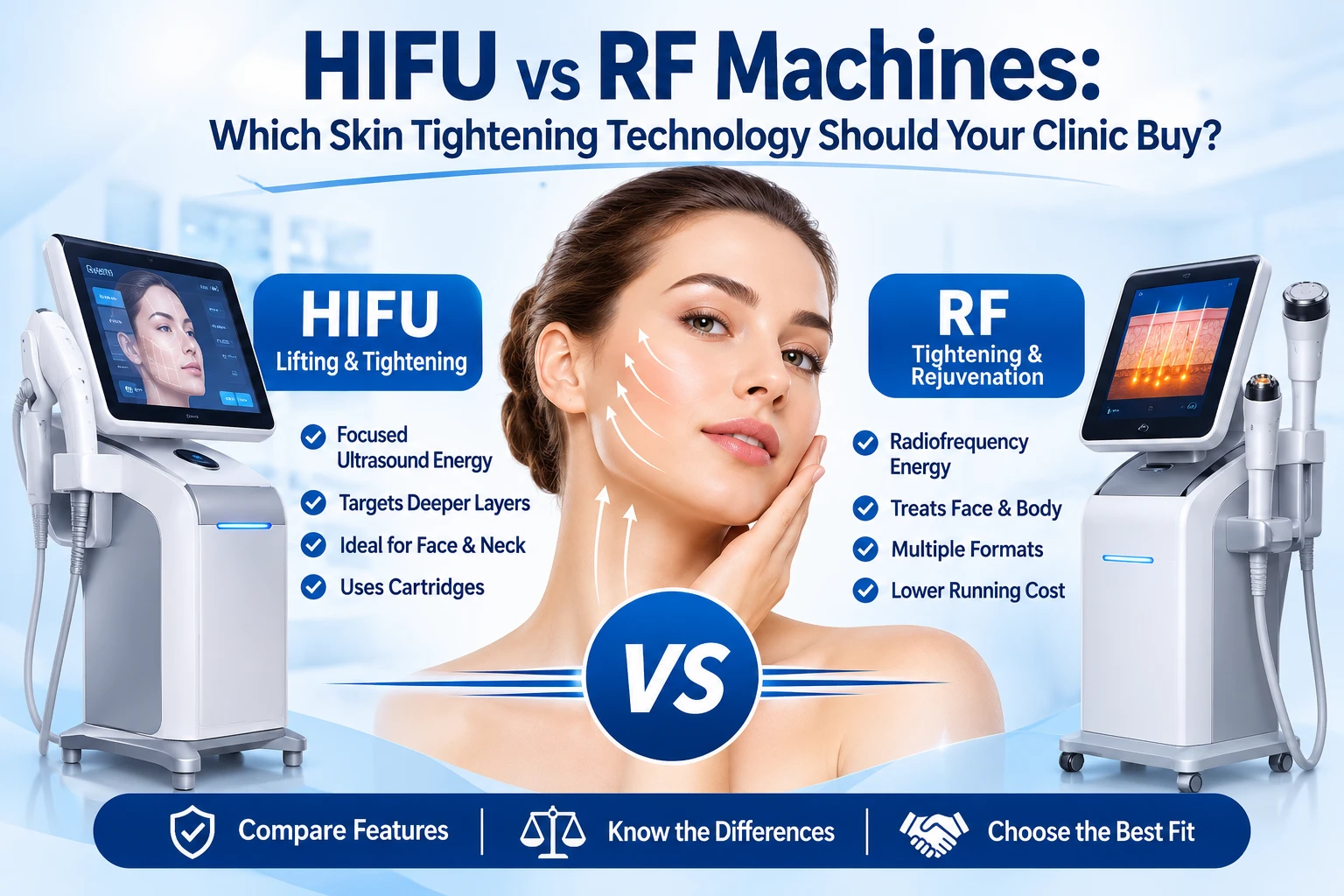
HIFU vs RF Machines: Which Skin Tightening Technology Should Your Clinic Buy?
HIFU and RF are the two technologies most buyers compare first when adding a non-invasive skin tightening device to a clinic or product line. They are often described as competitors, and suppliers sometimes imply that one is simply better. In practice they work differently, suit different treatment menus, and carry different cost and training profiles. The right choice depends on your clients, your business model, and the quality of the specific machine you are offered, not on the technology name alone.
This guide compares HIFU and RF for B2B buyers: how each works, where each fits, what the research supports, what to check before buying, and how to decide.
Quick Answer: HIFU or RF?
Choose HIFU if you want a focused-lifting service for the face and neck, you are comfortable managing cartridges as an ongoing cost, and your clients ask for non-surgical lifting.
Choose RF if you want a versatile tightening and rejuvenation service for face and body, a wider range of handpiece formats, and a lower-complexity add-on to an existing menu.
Choose a combination or multifunctional machine only if each module is well engineered, certified, and matched to treatments you will actually sell.
The sections below explain why.
What Is a HIFU Machine?
A HIFU machine delivers high-intensity focused ultrasound energy to defined depths beneath the skin. The energy is concentrated at a focal point, which allows a practitioner to target specific layers while leaving the surface of the skin unaffected. It is used in professional settings for non-invasive tightening and lifting of the face and neck, and some systems offer body applications. Our HIFU category collects our guides on this technology.
Peer-reviewed evidence supports the approach for the right candidates. A systematic review of microfocused ultrasound for facial skin tightening concluded that the treatment is effective for tightening mildly to moderately lax facial skin. That evidence concerns specific cleared systems, and a different manufacturer’s machine has to be judged on its own specifications and certification.
What Is an RF Machine?
RF stands for radiofrequency. An RF machine passes radiofrequency energy through the skin, which generates controlled heat in the tissue. That heat is intended to stimulate collagen and support firmer, smoother-looking skin. RF is used on the face, neck, and body, and it comes in several formats:
- Monopolar RF, which sends energy deeper and is often used for broader tightening
- Bipolar RF, which keeps energy between two electrodes and is often used for more superficial or sensitive areas
- Multipolar RF, which uses several electrodes to spread energy across the treatment area
- RF microneedling, which combines fine needles with RF energy for texture and laxity concerns
A review of radiofrequency in aesthetic surgery describes how RF energy generates thermal effects in tissue and summarizes the current evidence on its safety and efficacy across noninvasive and minimally invasive devices. Our RF machine category and RF technology category cover related devices.
How HIFU and RF Differ
Energy Type and Delivery
HIFU uses focused ultrasound, which concentrates energy at a point beneath the surface. RF uses electrical energy that heats tissue as it passes through. This is the core difference, and it explains most of the practical differences below.
Depth and Targeting
HIFU is built around depth selection through interchangeable cartridges, so a practitioner can aim at specific layers. RF depth depends on the format and settings, from shallower bipolar treatments to deeper monopolar ones. Ask any supplier to document the depth options and how they are verified.
Treatment Menu Fit
HIFU is usually positioned as a lifting service for the face and neck. RF is usually positioned as a tightening and rejuvenation service with broader application, including body treatments and combination protocols.
Consumables and Running Costs
HIFU systems typically rely on cartridges, which become an ongoing cost per treatment. Many RF systems rely more on reusable handpieces or electrodes, though RF microneedling uses disposable tips. Compare the cost per treatment, not only the machine price.
Training and Workflow
Both need trained operators. HIFU requires careful cartridge selection and placement. RF requires good control of energy settings, skin contact, and temperature. Either way, include training time in your launch plan.
Comparison at a Glance
| Factor | HIFU | RF |
|---|---|---|
| Energy | Focused ultrasound | Radiofrequency (electrical) heating |
| Typical positioning | Face and neck lifting | Tightening and rejuvenation, face and body |
| Depth control | Cartridge-based | Format and setting-based |
| Main ongoing cost | Cartridges | Handpiece wear, disposable tips for microneedling formats |
| Menu role | Flagship lifting service | Versatile add-on or base service |
| Typical buyer question | How good are the cartridges? | Which RF format and handpieces are included? |
Specific results, comfort, and downtime vary by device, settings, and the person treated, so confirm them with a demonstration rather than assuming from the table.
Which Should You Buy? A Guide by Business Type
Clinics and Medical Spas
If your clients ask for non-surgical lifting and you can price a premium service, HIFU can anchor your menu. If you want a flexible service that covers face and body and layers with other treatments, RF may give more variety per dollar. Many clinics eventually offer both. Our guide to choosing a professional facial machine explains how to sequence equipment purchases against demand.
Distributors
Carrying both technologies lets you serve clinics at different budget levels and with different menus. Train your sales team to explain the real differences, so that customers choose based on need rather than the loudest claim.
Private Label Brands
For brands, HIFU and RF are both well-established categories, which lowers the education burden but raises competition. Differentiation comes from build quality, cartridge or handpiece design, support, and branding. Our OEM vs ODM guide explains which manufacturing model suits your stage.
Combination and Multifunctional Machines
Some machines combine HIFU, RF, and other modules in one unit, and some use dual handpieces to run two functions. These can save space and widen your menu, but they carry risk: a module added to lengthen the feature list may be weakly engineered, and certification may need to cover each function separately. Our Dual Handpiece Aesthetic Maestro page shows how a two-handpiece format is specified. Ask to see every function demonstrated before you buy.
Cost and ROI Considerations
Build a landed cost model for each option:
- Machine price, shipping, duties, and training
- Consumables: HIFU cartridges, RF disposable tips if applicable, and replacement handpieces
- Revenue per treatment based on your market
- Cost per treatment, including consumables and practitioner time
- Realistic weekly treatment volume and break-even point
For HIFU-specific cost drivers, see our guide to HIFU machine price. Use conservative demand estimates. A machine with lower running costs and strong support can beat a cheaper one over time.
Certification and Compliance
Verify certification for the exact model and configuration, and understand which claims it supports. Do not describe any machine as FDA approved or cleared unless you can document that exact clearance for that exact model. Our guide on why CE, FDA, and ISO certifications matter explains what to request and how to check it. For multifunction machines, ask for coverage of each module.
Vetting the Manufacturer
Verify the factory address and registration, request references, and ask for a sample or detailed live demonstration before a bulk order. Get MOQ, lead time, warranty, spare parts support, and payment terms in writing. Our guide to finding a reliable beauty equipment manufacturer covers the full process.
Marketing Responsibly
Keep claims accurate for both technologies:
- Describe results as support for tighter, firmer-looking skin, not a replacement for surgery
- Avoid guaranteeing outcomes, and note that results vary by person and degree of laxity
- Use phrases such as designed to and may support instead of guarantees
- Do not borrow study results from other devices to promise results from yours
For where these technologies sit in the wider market, see our overview of 2026 beauty equipment trends.
Common Mistakes to Avoid
Treating Technology Names as Quality Guarantees
Two HIFU machines or two RF machines can differ greatly in build quality, energy stability, and support. Judge the machine, not just the label.
Comparing Machine Prices Without Running Costs
Cartridges, tips, and replacement handpieces can outweigh the price difference between quotes.
Buying Every Module
A unit with many functions looks impressive in a demo, but unused modules are wasted budget. Match the machine to demonstrated client demand.
Skipping the Demonstration
Request a sample or live demonstration and test each function before ordering in volume. See also the common mistakes new beauty equipment businesses make.
Frequently Asked Questions
HIFU uses focused ultrasound aimed at specific depths beneath the skin, while RF uses radiofrequency energy that heats tissue to stimulate collagen. HIFU is usually positioned for face and neck lifting, and RF for broader tightening and rejuvenation.
It depends on your clients and budget. HIFU suits clinics building a lifting service, while RF suits clinics wanting a versatile tightening service that covers face and body. Many clinics add the second technology later.
Yes, multifunctional machines exist. Verify that each module is well engineered and certified, and test every function before buying.
Both have peer-reviewed research behind them for skin tightening, with results strongest for mild to moderate laxity. Evidence applies to specific systems, so judge your own machine on its specifications and certification.
HIFU usually involves cartridges as an ongoing cost. RF running costs depend on the format, and microneedling formats use disposable tips. Compare cost per treatment across your options.
Yes. Many manufacturers offer OEM or ODM customization, including branding, packaging, and interface language. Confirm MOQ and certification transferability for customized orders.
Confirm certification for the exact model, verify the manufacturer, review cartridge or handpiece costs, get terms in writing, and request a demonstration.
Conclusion
HIFU and RF are complementary technologies, not a simple contest with one winner. HIFU tends to anchor a lifting service, and RF tends to give versatility across face and body. Choose based on your clients, your menu, your running costs, and the verified quality of the specific machine and supplier.
Ready to compare machines for your clinic or brand?
Contact our team for specifications, samples, and a quote.
Contact our team