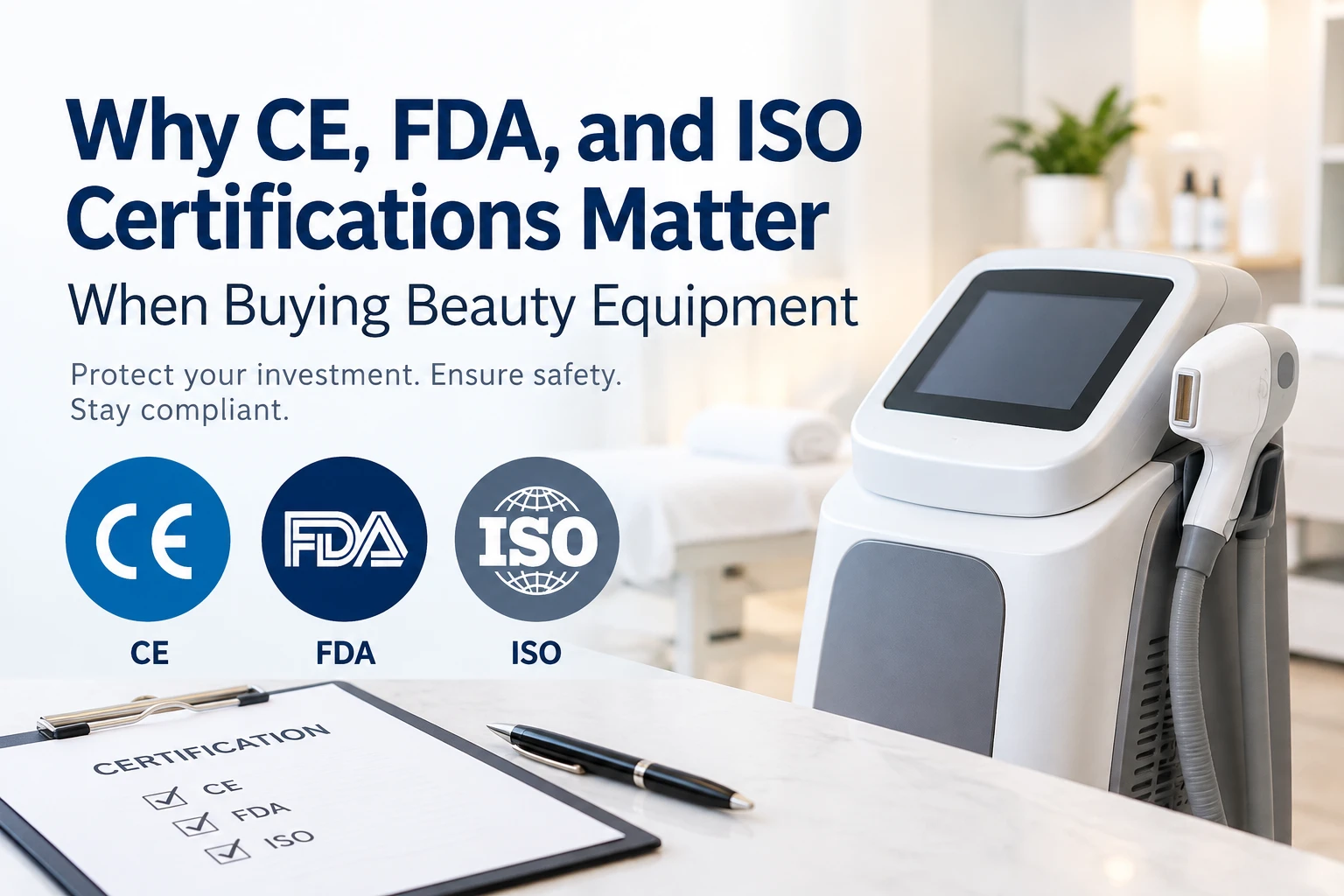
Why CE, FDA, and ISO Certifications Matter When Buying Beauty Equipment
A med spa owner in Texas found this out the hard way. She had sourced a diode laser hair removal system from a supplier offering a price nearly 40 percent below every other quote she had received. The device arrived with a professional looking brochure, a stated 810 nm wavelength, and a sticker that said "CE certified." Eighteen months later, a state health department inspection flagged the machine, not because it had broken down, but because it had never actually been cleared by the FDA as a medical device, and her state required 510(k) clearance for any laser procedure performed under a clinical scope of practice.
She lost use of the machine overnight, had to notify patients who had been treated with it, and started the entire sourcing process over from scratch, this time paying full price for a properly certified unit.
This is not a rare story in the beauty equipment industry. Certification confusion costs buyers real money, and sometimes their license to operate, every year. This guide breaks down what CE, FDA, and ISO certifications actually mean, why they are not optional paperwork, and how to verify a supplier’s claims before you sign a purchase order.
The good news is that verifying real certification takes only a few minutes once you know where to look and what to ask for. The businesses that get burned are almost always the ones who took a supplier’s word for it rather than checking the underlying documentation themselves.
What These Three Certifications Actually Mean
These three marks get thrown around loosely in beauty equipment marketing, and they do not all mean the same thing or come from the same authority.
CE Marking
CE marking indicates a product meets European Union health, safety, and environmental protection standards. For most electronics, this covers electrical safety and electromagnetic compatibility. For aesthetic devices with a medical claim or an energy-based mechanism, CE marking increasingly falls under the EU Medical Device Regulation (MDR 2017/745), a stricter framework than basic consumer electronics compliance.
FDA Clearance
In the United States, most energy-based aesthetic devices, including laser, radiofrequency, HIFU, IPL, cryolipolysis, and EMS equipment, are classified by the FDA as Class II medical devices requiring 510(k) premarket notification before they can be legally marketed. This is not a formality. It means a manufacturer has submitted technical documentation proving the device is substantially equivalent to an already-cleared predicate device.
ISO Certification
ISO certification is not one single thing either. ISO 9001 covers general quality management systems and applies broadly across industries. ISO 13485 is the standard specifically built for medical device manufacturers, covering design controls, risk management, and traceability requirements that ISO 9001 does not touch. A supplier holding ISO 13485 has been audited against a meaningfully higher bar than one holding only ISO 9001.
Why Beauty Equipment Certification Is Not Optional Anymore
Regulatory oversight of beauty devices has tightened significantly in recent years, on both sides of the Atlantic. The EU’s Annex XVI provision under MDR brought previously unregulated cosmetic devices, including certain skin-resurfacing and body-contouring equipment, into the same medical device framework used for surgical instruments.
In the US, the FDA has issued revised safety communications concerning RF microneedling devices following reports of burns, scarring, and nerve injuries tied to uncertified or improperly cleared units. Regulators are not chasing paperwork for its own sake. Real patient and client harm from uncertified equipment is what is driving the tightening rules.
For buyers, this means the certification gap between a properly cleared device and an uncertified look-alike has gotten wider, not narrower, and the consequences of getting it wrong have gotten more serious.
CE Marking: What It Covers and What It Doesn't
A CE mark on a beauty device tells you the manufacturer has self-declared, or in higher-risk cases had a Notified Body assess, conformity with applicable EU directives or regulations. What it does not automatically tell you is which framework applies.
A basic LED facial device sold purely as a cosmetic wellness product might only need to comply with the Low Voltage Directive and EMC Directive. A radiofrequency skin-tightening device making therapeutic claims may fall under full MDR requirements, involving a Notified Body number, a Declaration of Conformity, and technical documentation on file. If a supplier cannot tell you which framework their CE mark falls under, or cannot produce a Declaration of Conformity on request, that is a warning sign worth taking seriously.
The Difference Between "CE" and Counterfeit "China Export" Marks
One detail catches even experienced buyers off guard. There are technically two different marks that look nearly identical on a product label, the genuine European Conformity CE mark and an unofficial "China Export" mark that uses the same two letters styled slightly differently.
The genuine EU CE mark has specific proportions and spacing defined in EU regulation, while the counterfeit version is often subtly wider or uses different letter spacing. This is not a widely known distinction, and it is exactly the kind of detail an unscrupulous seller can exploit without technically lying about anything printed on the box. Requesting the actual Declaration of Conformity document, rather than relying on the printed mark alone, sidesteps this problem entirely since a counterfeit mark has no legitimate documentation behind it.
FDA Clearance: Medical-Grade vs Cosmetic-Grade Devices
The terms "medical-grade" and "cosmetic-grade" get used constantly in supplier marketing, but they are not quality tiers, they are regulatory categories with real legal weight behind them.
| Category | Regulatory Status | Who Can Legally Operate It |
|---|---|---|
| Cosmetic-grade, no medical claim | No FDA clearance required | Generally unrestricted, home or spa use |
| Class II, 510(k) cleared | FDA cleared for stated indication | Often restricted to licensed or supervised operators depending on state law |
| Class III (rare in aesthetics) | FDA approved via PMA pathway | Physician-administered only |
A device marketed as "medical-grade" without an actual 510(k) clearance number is making an unsubstantiated claim. Ask your supplier for the specific FDA 510(k) number, then verify it directly against the FDA’s own database rather than taking a brochure’s word for it.
ISO 13485 vs ISO 9001: Why the Distinction Matters for Manufacturers
When evaluating an OEM or ODM supplier, the specific ISO standard they hold tells you a lot about how seriously they treat quality control on medical and aesthetic equipment specifically.
ISO 9001 confirms a manufacturer has a documented, consistent quality management process, which is a reasonable baseline for general manufacturing. ISO 13485 goes further, requiring documented risk management throughout the design and manufacturing process, full traceability of components and batches, and specific controls around device labeling and post-market surveillance.
For a buyer sourcing equipment that will be used on clients’ skin, muscles, or tissue, ISO 13485 is the more relevant signal of manufacturing discipline. A supplier who only holds ISO 9001 is not automatically untrustworthy, but they have not been audited against the standard built for the risks specific to medical and aesthetic devices.
What Happens When You Buy Uncertified Equipment
The risks of skipping certification checks go well beyond a bad customer experience.
Customs authorities in the US, EU, and many other markets can and do seize shipments of aesthetic devices lacking proper certification documentation, leaving the buyer out the full purchase cost with no product to show for it. Insurance providers frequently exclude coverage for treatments performed with uncertified equipment, meaning a single adverse client outcome could leave a salon or clinic personally liable for damages.
Regulatory inspections, whether from a state health department, a cosmetology board, or an EU market surveillance authority, can result in equipment seizure, fines, or a full suspension of your ability to operate specific treatments, exactly what happened to the med spa owner in this article’s opening story.
How to Verify a Supplier's Certifications Are Real
Do not take a certification claim at face value, regardless of how professional the supplier’s marketing materials look. A few minutes of verification prevents a very expensive mistake.
For FDA clearance, search the device or company name directly in the FDA’s 510(k) Premarket Notification Database to confirm the clearance number matches the specific device and manufacturer you are buying from, not just a similarly named product. For CE marking on higher-risk devices, ask for the Notified Body number and cross-check it against the European Commission’s NANDO database of authorized certification bodies. For ISO certification, request the certificate directly and confirm it names the specific facility manufacturing your equipment, not just a parent company or an unrelated affiliate.
A legitimate supplier will not hesitate to provide this documentation. Hesitation, vague answers, or an inability to produce specific certificate numbers is itself useful information.
Certification Requirements by Device Type
Different categories of beauty equipment carry different typical certification expectations, based on how the device interacts with the body.
| Device Type | Typical US Classification | Typical Certification Signal to Verify |
|---|---|---|
| Laser hair removal | FDA Class II, 510(k) required | 510(k) clearance number, CE under MDR |
| RF skin tightening | FDA Class II, 510(k) required | 510(k) clearance number, ISO 13485 |
| HIFU body contouring | FDA Class II, 510(k) required | 510(k) clearance number, CE under MDR |
| Microcurrent facial devices | Often FDA Class II depending on claims | 510(k) status, ISO 13485 preferred |
| LED light therapy | Often exempt or Class I | Basic CE (LVD/EMC), general safety testing |
| Cryolipolysis | FDA Class II, 510(k) required | 510(k) clearance number, CE under MDR |
This table is a general guide, not a legal determination for any specific device. Classification depends on the manufacturer’s stated intended use and marketing claims, so always confirm the exact classification for the specific model you are purchasing.
Questions to Ask Your Beauty Equipment Supplier Before Buying
A short, direct list of questions during the sourcing process separates serious manufacturers from resellers hoping you will not ask.
Ask for the exact FDA 510(k) clearance number, if applicable, and the specific device name it was cleared under. Ask which CE framework applies to the device, Low Voltage Directive, EMC Directive, or full Medical Device Regulation, and request the Declaration of Conformity document. Ask whether the manufacturing facility holds ISO 13485, not just ISO 9001, and request a current certificate naming that specific facility. Finally, ask how the supplier handles documentation for buyers reselling or operating the equipment under regulatory oversight in your specific country or state, since requirements vary significantly by jurisdiction.
How OEM Manufacturers Should Handle Certification Documentation
For manufacturers and OEM suppliers reading this from the other side of the transaction, the businesses that win long-term B2B trust are the ones who make certification documentation easy to access before a buyer even has to ask. Publishing 510(k) numbers, CE Declarations of Conformity, and current ISO 13485 certificates directly on product pages removes friction from the sourcing decision and signals confidence rather than something to hide.
A Quick Comparison: Certified vs Uncertified Sourcing
Two buyers sourcing the same category of RF skin-tightening device illustrate how differently this plays out in practice. One buyer paid roughly 15 percent more for a unit from a manufacturer who provided the 510(k) clearance number, a full MDR Declaration of Conformity, and an ISO 13485 certificate naming the exact production facility, all before the deposit was paid. The other buyer chose a cheaper supplier whose only certification proof was a stock photo of a CE logo pasted into a product brochure.
The first buyer passed a routine state inspection eight months later without incident. The second buyer had their equipment flagged during a customs inspection on a separate reorder, resulting in a seized shipment and a multi-week gap in their treatment offerings while they sourced a replacement from a properly documented supplier. The price difference upfront was a fraction of what the second buyer ultimately lost in downtime and a wasted shipment.
Frequently Asked Questions
What is the difference between CE marking and FDA clearance?
CE marking applies to products sold in the European Union and confirms compliance with EU health, safety, and environmental standards, while FDA clearance applies specifically to the US market and confirms a device has passed the agency’s premarket review process. A device can legally hold one without the other, so buyers selling internationally need to confirm both separately.
Is ISO 13485 required to sell beauty equipment?
ISO 13485 is not legally required in every market, but it is the internationally recognized quality standard for medical device manufacturing and is often required by distributors, regulators, or import authorities in stricter markets. Suppliers holding it demonstrate a higher level of manufacturing discipline specific to medical and aesthetic devices.
How do I check if a device's FDA clearance is real?
Search the device or manufacturer name directly in the FDA’s 510(k) Premarket Notification Database and confirm the clearance number matches the exact device and company you are purchasing from, not a similarly named product or an unrelated entity.
Can I get in trouble for using uncertified beauty equipment in my salon?
Yes, depending on your state or country’s regulations, using uncertified equipment can result in fines, equipment seizure, license suspension, and denied insurance coverage in the event of a client injury claim.
Does every beauty device need FDA clearance?
No, purely cosmetic devices with no therapeutic or medical claim, such as basic LED wellness devices, are often exempt or classified as lower risk. Energy-based devices like lasers, RF, and HIFU equipment generally do require 510(k) clearance due to their higher risk profile.
Final Thoughts
The med spa owner from the start of this guide eventually rebuilt her sourcing process around one simple rule: verify before you buy, not after an inspector asks. Certification numbers, Declarations of Conformity, and ISO certificates take a few minutes to check and cost nothing to request. Skipping that step is what turns a good deal into a very expensive lesson.