
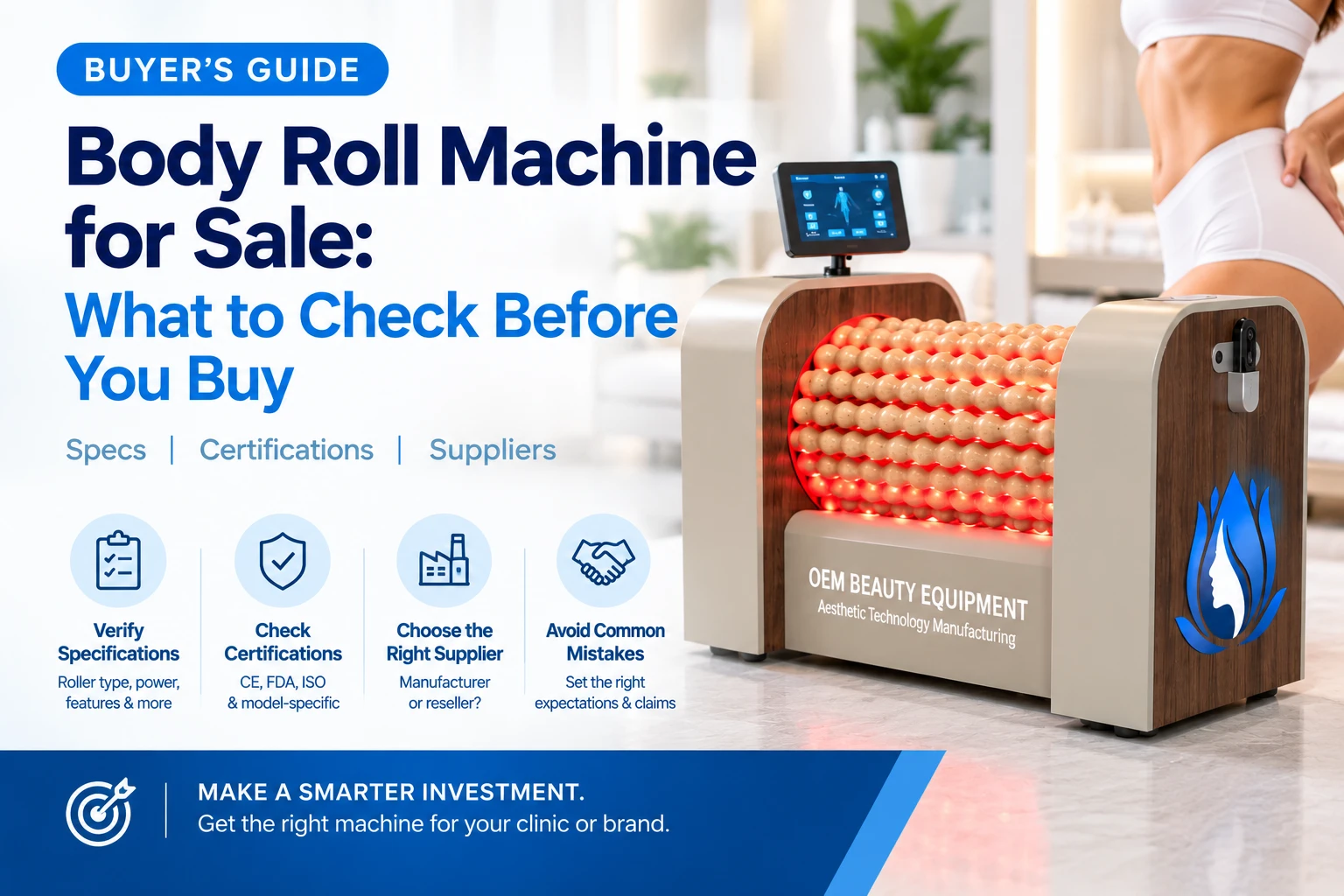
Body Roll Machine for Sale: What to Check Before You Buy
If you’re searching “body roll machine for sale,” you’re likely past the research stage and into active sourcing, comparing listings, weighing suppliers, and trying to figure out which quote actually represents good value rather than just the lowest number on a page. This guide is built for that stage. It’s not a general explainer of how roller-based body contouring works, that’s covered in detail elsewhere in this series, it’s a practical checklist for evaluating specific listings and suppliers before you commit to a purchase order.
Before You Compare Prices, Define What You’re Actually Buying
“Body roll machine” functions as a broad category label across supplier listings, and as covered in earlier guides in this series, it can refer to anything from a basic single-roller device to a multi-zone machine combining rolling with vacuum or light-based elements. Before comparing prices across listings, confirm you’re actually comparing equivalent products.
Questions to Answer Before Requesting Quotes
- Is this a purely mechanical roller, or does it combine rolling with vacuum, compression, or an energy-based element?
- Is it designed for a specific treatment area (abdomen, legs, arms) or marketed as general-purpose?
- Is it a single-zone unit or a multi-zone/multi-attachment machine?
- What’s the intended use case: general body shaping, cellulite appearance, lymphatic-style support, or a combination?
Getting clear on these answers first means you can request genuinely comparable quotes, rather than ending up with a spreadsheet of prices for fundamentally different products that happen to share a category name.
“Body Slimming Cellulite Removal”: Setting Accurate Expectations
Many listings in this category use language like “body slimming cellulite removal for professional use.” Before you buy a machine with this positioning, and before you use that language in your own marketing, it’s worth understanding what the term “removal” actually implies versus what mechanical roller equipment can reasonably support.
Cellulite is a structural characteristic of subcutaneous fat and connective tissue, and current clinical understanding doesn’t support the idea that any non-invasive mechanical device permanently “removes” it. What mechanical rolling may support, consistent with the general lymphatic and tissue-massage rationale covered throughout this series, is a temporary smoothing effect on skin texture and appearance, achieved through repeated sessions, not a permanent structural change.
This distinction matters directly for your business: marketing language that promises “cellulite removal” rather than “appearance of cellulite reduction” or “skin smoothing” sets expectations the equipment likely can’t meet, which creates both client dissatisfaction risk and potential regulatory exposure depending on your market’s advertising standards for cosmetic claims. When evaluating a machine for sale, don’t let aggressive marketing language in the listing itself set your own client-facing claims; verify what the device mechanically does, then write your own marketing conservatively based on that.
What to Check on Any “For Sale” Listing
1. Full Technical Specification, Not Just Marketing Copy
Request the actual spec sheet: roller count and material, motor power and rating, adjustable pressure or speed range, treatment area dimensions, and any additional components (vacuum, compression, light-based elements). A listing heavy on marketing language and light on verifiable technical detail is a signal to ask more questions before proceeding, not necessarily a dealbreaker, but a prompt for due diligence.
2. Certification Documentation for the Exact Model
This is one of the most commonly skipped checks, and one of the most important. Confirm the listing’s certifications, CE, FDA, ISO, or others relevant to your market, apply to the specific model and configuration you’re buying, not a similar model in the same product family. Our guide on why CE, FDA, and ISO certifications matter explains exactly what documentation to request and how to verify it independently.
3. Manufacturer vs. Reseller Status
Determine whether you’re buying directly from the manufacturer or through a reseller or trading company. This affects pricing, your ability to negotiate customization, and your access to direct technical support. Neither option is automatically wrong, but you should know which one you’re dealing with before negotiating price or terms. Our guide on finding a reliable beauty equipment manufacturer covers how to verify a supplier’s actual status and legitimacy.
4. MOQ, Pricing Structure, and Payment Terms
Get clear, written answers on minimum order quantity, unit pricing at different order volumes, deposit and balance payment structure, and what happens if production or shipping is delayed. Vague or shifting answers to these specific questions are a warning sign worth taking seriously.
5. Warranty and After-Sales Support
Confirm the warranty period, how spare parts and replacement components are supplied, and what the typical response time is for technical support requests. A roller-based machine has moving mechanical parts that will eventually need servicing or replacement; know what that process looks like before you buy, not after something breaks.
6. Sample or Live Demonstration Availability
Before committing to a bulk order, request either a sample unit or a detailed live video demonstration covering every function the listing describes. This is the single most effective way to confirm a device performs as advertised before you’re financially committed to a larger order.
Red Flags Worth Taking Seriously
- Price significantly below comparable listings with no clear explanation
- No verifiable certification documentation for the specific model
- Reluctance to provide a sample or live demonstration
- Vague or inconsistent answers about manufacturing location, MOQ, or lead time
- Marketing language promising permanent or guaranteed results (“removes cellulite permanently,” “clinically proven” without supporting documentation)
- No clear warranty or after-sales support policy
Any single item here warrants a follow-up question rather than an automatic disqualification, but more than one together is a strong signal to look elsewhere. This overlaps directly with the broader sourcing mistakes covered in our guide on common mistakes beauty equipment businesses make.
Comparing Multiple “For Sale” Listings Side by Side
When you have several quotes in hand, build a simple comparison rather than defaulting to the lowest price:
| Factor | Listing A | Listing B | Listing C |
|---|---|---|---|
| Mechanism (rolling only, or combined) | |||
| Treatment area(s) designed for | |||
| Certifications confirmed for this exact model | |||
| MOQ and unit price at your target volume | |||
| Warranty length | |||
| Sample available? | |||
| Manufacturer or reseller? |
Filling this out before making a decision turns a potentially overwhelming set of listings into a structured comparison, and it often reveals that the lowest-priced option isn’t actually comparable to the others once mechanism, certification, and support are accounted for.
If You’re Buying for a Private Label Brand
If your end goal is reselling this equipment under your own brand rather than operating it in your own clinic, a few additional questions matter:
- Can the manufacturer support OEM or ODM customization at your target order volume? Our OEM vs ODM guide explains the trade-offs between these two approaches.
- Who owns the certification, and can it transfer to or be referenced under your brand name, or do you need separate certification for your branded version?
- What packaging, branding, and user manual customization options are available, and at what MOQ?
These questions apply whether you’re sourcing a basic body roll machine or any of the related combination devices covered elsewhere in this series, including lymphatic drainage roller machines and infrared or red light combination rollers.
A Pre-Purchase Checklist
Before finalizing any body roll machine purchase:
- Confirmed the exact mechanism and treatment area design
- Received and verified certification documentation for the specific model
- Confirmed whether you’re buying from a manufacturer or reseller
- Received written MOQ, pricing, and payment terms
- Confirmed warranty length and spare parts/support process
- Requested and reviewed a sample or live demonstration
- Checked the listing’s marketing claims against what the mechanism can reasonably support
- For private label buyers: confirmed OEM/ODM customization options and certification transferability
Frequently Asked Questions
What should I check first when looking at a body roll machine for sale?
Start with the actual technical specification, roller configuration, treatment area design, and whether it combines rolling with other elements like vacuum or light therapy, before comparing prices. Comparing listings without confirming they’re equivalent products leads to misleading price comparisons.
Can a body roll machine really remove cellulite?
No non-invasive mechanical device permanently removes cellulite, since it’s a structural characteristic of subcutaneous tissue. Mechanical rolling may support a temporary smoothing effect on skin appearance through repeated sessions. Be cautious of listings or marketing language promising permanent removal.
How do I know if the certifications on a listing are legitimate?
Request the actual certification documents and confirm they name the specific model and configuration you’re buying, not a similar product in the same range. Cross-check documentation with the relevant regulatory body’s public database where available.
Should I buy directly from a manufacturer or through a reseller?
Both can work, but you should know which you’re dealing with. Direct manufacturer purchases often allow more customization and potentially better pricing at volume, while resellers may offer lower MOQs or faster availability. Confirm the supplier’s actual status before negotiating.
What’s a reasonable MOQ for a body roll machine?
MOQ varies significantly by manufacturer and configuration. There’s no universal standard, so request this directly and in writing rather than assuming based on other categories or suppliers you’ve worked with.
Can I get a body roll machine customized for my own brand?
Yes, many manufacturers offer OEM or ODM customization. Confirm certification transferability and MOQ for customized orders specifically, since these often differ from standard product MOQs.
Conclusion: Buy the Specification, Not the Listing Title
“Body roll machine for sale” covers a wide enough range of actual products that the listing title alone tells you very little. The buyers who end up satisfied with this purchase are the ones who requested the full technical specification, verified certification for the exact model, checked the manufacturer’s legitimacy, and set their own marketing claims based on what the equipment can reasonably support, not on what the most aggressive listing in their search results promised.
Take the time to work through the checklist above before committing, and you’ll avoid the most common, and most costly, mistakes buyers make in this category.