
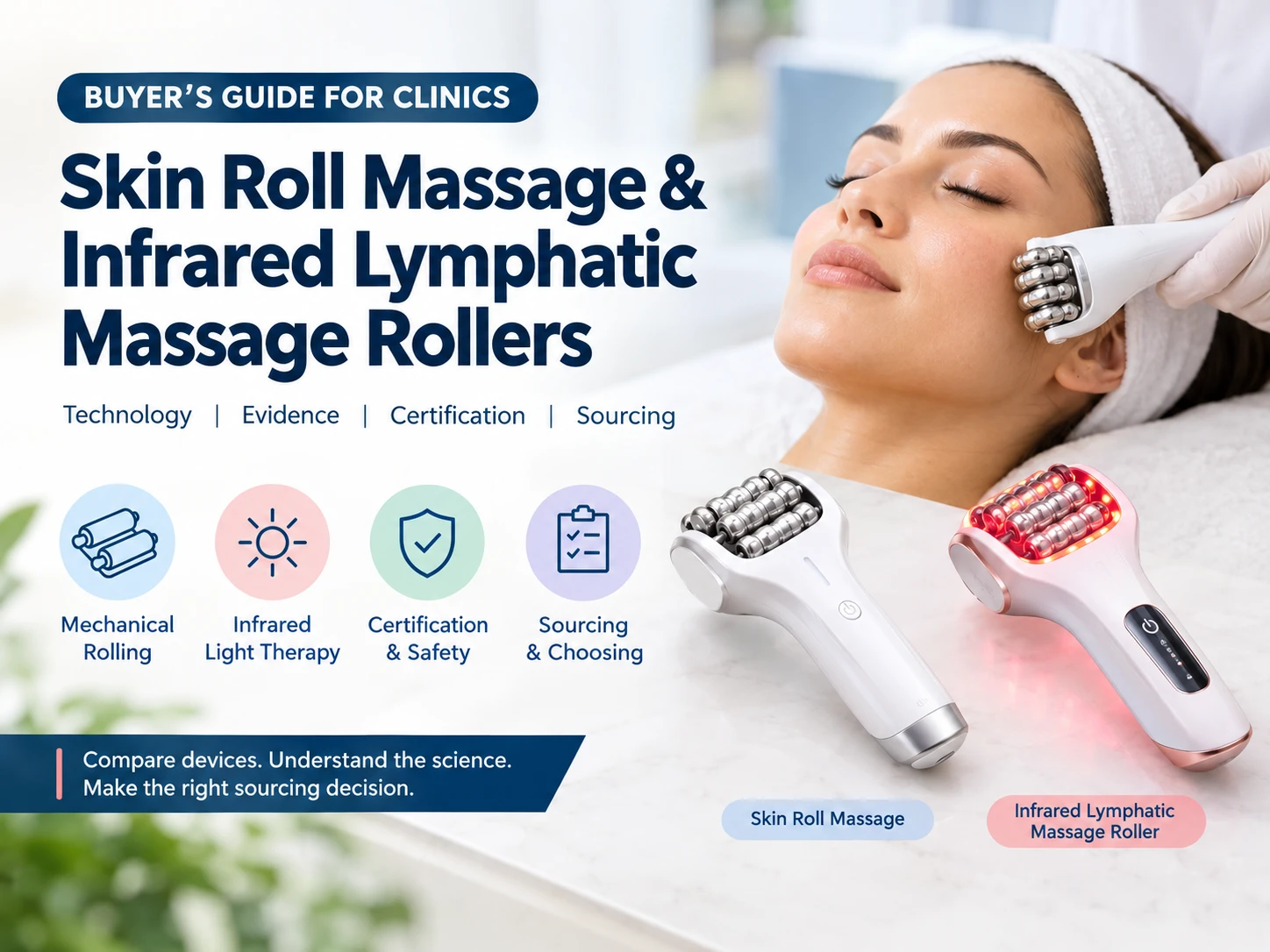
Skin Roll Massage & Infrared Lymphatic Massage Rollers: A Buyer’s Guide for Clinics
Two closely related product types frequently show up side by side in beauty equipment catalogs: skin roll massage devices and infrared lymphatic massage rollers. The first is a purely mechanical category. The second adds a light-based element to the same basic rolling mechanism, and is positioned around a different set of claims entirely. For a B2B buyer, understanding exactly what the “infrared” addition changes, and what it doesn’t, is the difference between making an informed sourcing decision and paying a premium for a feature you can’t accurately explain to your own clients.
This guide covers both categories: what each is, how the infrared addition works mechanically, what the current research actually supports, and how to evaluate and source either one for a clinic, distribution business, or private label brand.
What Is Skin Roll Massage?
Skin roll massage refers to a treatment and device category built around purely mechanical rolling action applied to the skin’s surface. Unlike energy-based technologies, there’s no added light, heat, or electrical stimulation involved, just motorized rollers moving across the treatment area to apply pressure and motion.
This category typically overlaps with broader roller-based equipment discussed elsewhere in this series, but “skin roll massage” specifically tends to emphasize the surface-level, massage-like nature of the treatment rather than deeper tissue or lymphatic framing. It’s often positioned as a relaxing, lower-intensity treatment suitable for a wide range of skin types and client tolerances.
Core Mechanism
A skin roll massage device typically includes:
- Motorized rollers, often smaller and more precisely controlled than body-area roller devices, sized for facial or targeted skin treatment
- Adjustable speed and pressure settings
- Simple, low-complexity electronics, since there’s no added energy-based technology to manage
Because this category is mechanically straightforward, it tends to be one of the lower-cost, lower-risk entry points into roller-based equipment, both for clinics adding it to a menu and for brands sourcing a private label version.
What Is an Infrared Lymphatic Massage Roller?
An infrared lymphatic massage roller takes the same core rolling mechanism and adds an infrared light-emitting element, typically built into the roller head or housing, delivered alongside the mechanical massage action. This combination is positioned around two claims working together: the mechanical support for lymphatic-style drainage discussed in earlier guides in this series, and the separate physiological effects associated with infrared light exposure.
How the Infrared Component Works
Infrared light therapy, often discussed under the broader clinical term photobiomodulation, involves exposing tissue to red or near-infrared wavelengths, generally in the 600–1100 nanometer range. A comprehensive peer-reviewed review of photobiomodulation in dermatology describes this light exposure as working primarily through photochemical effects at the cellular level rather than through heat, with research exploring applications including collagen stimulation, inflammation modulation, and wound healing support.
It’s important to be precise about what this research does and doesn’t establish for a device like an infrared lymphatic massage roller specifically:
- The research base for photobiomodulation’s cellular-level effects is genuinely substantial and growing, particularly for skin and wound-healing applications.
- Much of this research involves dedicated light therapy devices (LED panels, masks, standalone light sources) studied independently of a simultaneous mechanical rolling component.
- Research combining infrared light exposure specifically with mechanical rolling, as a single integrated device, is far more limited, meaning the “lymphatic” framing of these combination products draws more on the general rolling-based lymphatic rationale (covered in earlier guides in this series) than on infrared-specific lymphatic research.
For a B2B buyer, this distinction matters directly for how you market these devices. It’s reasonable to describe infrared light exposure as an area of active research interest in skin and tissue applications. It’s a stretch, and a liability risk, to claim that a specific combination roller-and-infrared device has been clinically proven to enhance lymphatic drainage beyond what the mechanical rolling alone would provide, since that specific combined claim isn’t well supported by the current literature.
Comparison at a Glance
| Factor | Skin Roll Massage | Infrared Lymphatic Massage Roller |
|---|---|---|
| Core mechanism | Mechanical rolling only | Mechanical rolling + infrared light element |
| Technical complexity | Lower | Moderate (added light source and controls) |
| Manufacturing cost | Lower | Higher, due to added component |
| Research basis | Limited aesthetic-specific research | Strong general photobiomodulation research; limited research on the specific combined device format |
| Typical positioning | Relaxing, general surface treatment | Positioned around lymphatic and skin benefits combined |
| Claims risk | Lower, if marketed conservatively | Higher, requires careful separation of mechanical vs. light-based claims |
Why This Distinction Matters for Sourcing and Marketing
Pricing the Added Component Appropriately
An infrared lymphatic massage roller should cost more than a basic skin roll massage device, reflecting the genuine added component, the light source, its power supply, and associated safety controls. If a supplier is charging a significant premium for the “infrared” label without a verifiable light-emitting component meeting a documented wavelength and output specification, you’re paying for marketing, not hardware. Always request the specific wavelength range and output specification for any infrared-claiming device, the same way you’d request a technical spec for any other technology category.
Separating Your Claims Accurately
Given the research landscape described above, the responsible approach to marketing an infrared lymphatic massage roller is to describe the two elements separately and honestly:
- The mechanical rolling component, with the same general lymphatic-support framing used for other roller-based equipment in this category
- The infrared light component, described in terms of the general photobiomodulation research base, without implying this specific combined product has been independently clinically validated
This approach protects you from overclaiming while still letting you market a genuinely differentiated, higher-value product compared to a basic skin roll massage device.
Certification Considerations
Adding a light-emitting component changes the certification picture. A purely mechanical skin roll massage device generally has a more straightforward certification path. An infrared lymphatic massage roller, because it incorporates a light-emitting element, may need to meet additional safety standards specific to light-based devices, separate from whatever certification covers the mechanical rolling function. Our guide on why CE, FDA, and ISO certifications matter explains how to request and verify documentation; for a combination device like this, make sure you’re requesting certification coverage for both the mechanical and light-based elements specifically, not assuming one certificate covers the full device.
Evaluating These Devices as a Buyer
For Clinics
If you’re deciding between a basic skin roll massage device and an infrared version, consider:
- Your client base’s expectations. Clients increasingly recognize “infrared” and “red light therapy” terminology from wellness marketing broadly, which can make the infrared version easier to sell at a premium, provided your claims stay accurate.
- Your staff’s ability to explain the treatment accurately. Both the mechanical and light-based elements deserve clear, honest explanation to clients, not vague “detox” or “clinically proven” language.
- Your existing equipment lineup. If you already offer dedicated LED or infrared light therapy devices, a combination roller may be redundant rather than additive. If you don’t, it can be a reasonable way to introduce light-based treatment benefits without a separate equipment purchase. For guidance on sequencing equipment purchases against your existing menu, see our guide to choosing a professional facial machine, which covers the same layering logic.
For Distributors
Carrying both tiers, a basic skin roll massage device and an infrared version, gives you pricing flexibility across different clinic budgets. Make sure your sales materials and team training clearly explain what the infrared addition actually does and doesn’t add, so you’re not inadvertently passing along inflated claims from a supplier to your own customers.
For Private Label Brands
If you’re building a product line around this category, our OEM vs ODM guide explains the trade-offs between a custom design and customizing an existing model. For an infrared lymphatic massage roller specifically, confirm with your manufacturer:
- The exact LED or light source specification, including wavelength range and output
- Whether the light and mechanical components are independently certified
- Whether the manufacturer can produce a lower-cost, non-infrared variant of the same roller mechanism if you want to offer tiered pricing in your own product line
As always, verify the manufacturer is legitimate and well-documented before committing. Our guide on finding a reliable beauty equipment manufacturer covers exactly how to vet a factory and request proper documentation, which matters especially here given the added technical complexity of a combination device.
Common Mistakes to Avoid
Assuming “Infrared” Automatically Justifies a Large Price Premium
Request the actual component specification before accepting a significant price difference. A verified, properly specified light source justifies a premium; a vague “infrared” label without documentation does not.
Conflating General Photobiomodulation Research With Combined-Device Claims
The broader research on infrared light and skin is genuinely strong. The research on a specific mechanical-roller-plus-infrared combination device is much thinner. Keep these two claims separate in your marketing.
Overlooking Certification for the Light Component Specifically
Don’t assume a general CE or FDA certificate for the device automatically covers the light-emitting element to the same standard as a dedicated light therapy device. Ask specifically.
Buying Without a Sample or Live Demonstration
Given the added complexity of a combination device, a sample or live demonstration matters even more here than with a purely mechanical device, both to confirm build quality and to see the light component functioning as specified.
Frequently Asked Questions
What’s the difference between skin roll massage and an infrared lymphatic massage roller?
Skin roll massage is a purely mechanical treatment using motorized rollers. An infrared lymphatic massage roller adds a light-emitting element to the same rolling mechanism, combining mechanical massage with infrared light exposure.
Is there research supporting infrared light therapy for skin?
Yes, there’s a substantial and growing body of peer-reviewed research on photobiomodulation (red and near-infrared light therapy) for skin applications, including collagen stimulation and inflammation modulation. However, research specifically on combined roller-and-infrared devices is more limited than research on dedicated light therapy devices.
Should an infrared lymphatic massage roller cost more than a basic skin roll massage device?
Yes, reasonably, since it includes an additional light-emitting component with its own cost and certification requirements. Request the specific light source specification to confirm the premium reflects real added hardware.
What certifications should I check for an infrared lymphatic massage roller?
Confirm certification coverage for both the mechanical rolling function and the light-emitting component specifically, since combination devices may need to meet separate safety standards for each element.
Can these devices be customized for a private label brand?
Yes, both categories are commonly available through OEM or ODM arrangements. For infrared versions, confirm the exact light source specification and whether it’s independently certified, in addition to standard mechanical and branding customization options.
How should I market the “lymphatic” and “infrared” claims accurately to clients?
Describe the mechanical and light-based elements separately and conservatively. Reference the mechanical rolling’s general lymphatic-support rationale and the infrared component’s general photobiomodulation research base, without implying the specific combined device has been independently clinically validated for lymphatic outcomes.
Conclusion: Verify the Hardware Behind the Claims
Skin roll massage and infrared lymphatic massage rollers represent two tiers of the same core product category, one purely mechanical, one with an added light-based component carrying its own research context, cost structure, and certification requirements. For B2B buyers, the path forward is consistent with every other category in this series: request the actual technical specification, verify certification for each distinct component, separate your marketing claims according to what the evidence actually supports, and vet your manufacturer thoroughly before committing to an order.