
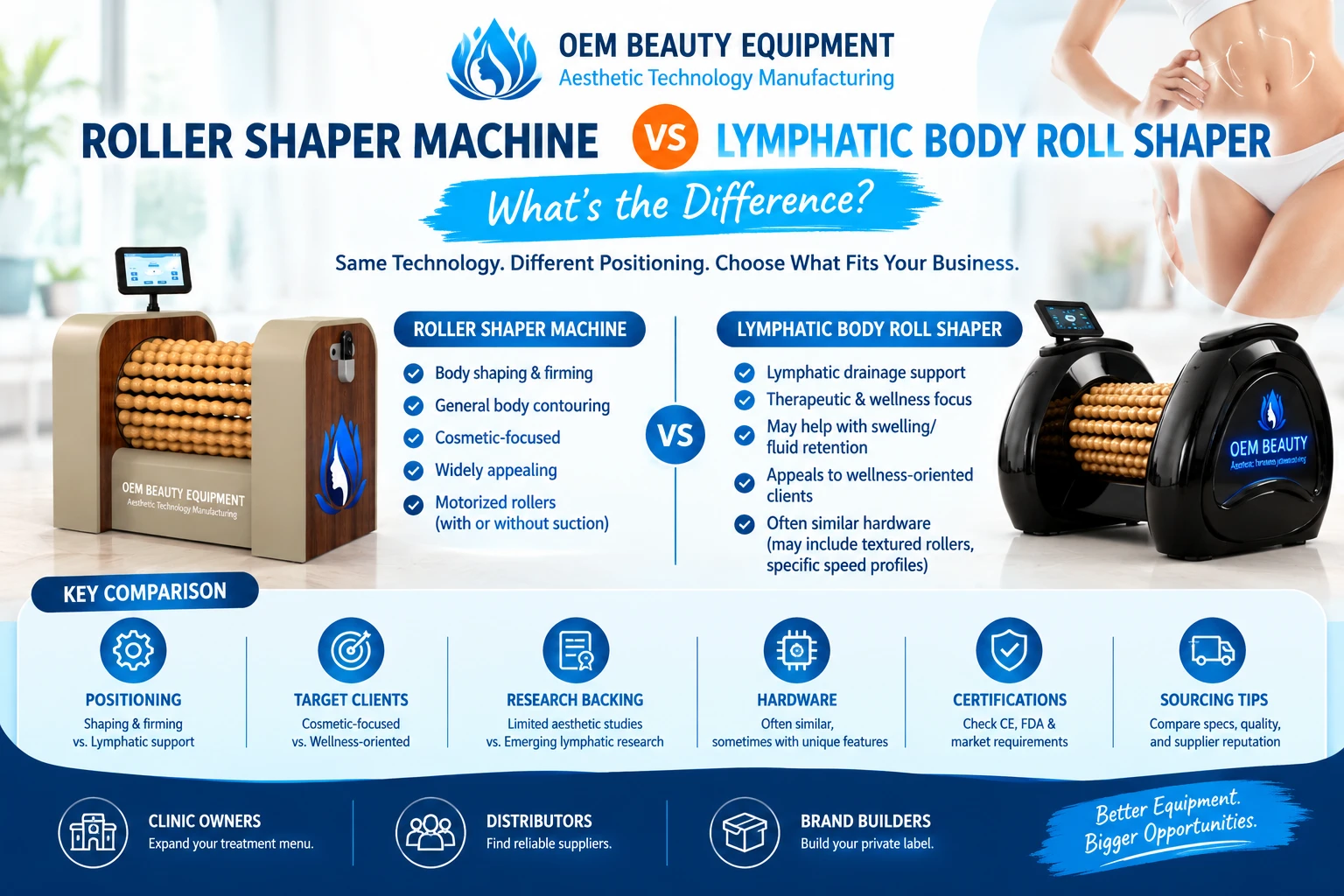
Roller Shaper Machine vs. Lymphatic Body Roll Shaper: A Buyer’s Guide
If you’ve spent any time browsing supplier catalogs in the body contouring equipment space, you’ve likely run into two closely related but distinct terms: roller shaper machine and lymphatic body roll shaper. They sound similar, often sit in the same product category on a distributor’s website, and are frequently manufactured by the same factories. But they’re positioned differently, built around slightly different design priorities, and matter differently depending on whether you’re a clinic owner, a distributor, or a private label brand.
This guide walks through what separates these two product types, what each is actually built to do, and how to evaluate them as a sourcing decision rather than a marketing comparison.
What Is a Roller Shaper Machine?
A roller shaper machine is a general-purpose body contouring device built around motorized rollers designed to work on body shape and contour. The term “shaper” signals the primary positioning: this equipment is marketed around visible body shaping and firming outcomes, generally for the abdomen, thighs, arms, or back.
Roller shaper machines typically emphasize:
- Shaping and firming as the primary client-facing benefit
- General body contouring rather than a specific therapeutic framing
- Broader marketing appeal, since “shaper” is an easier concept for clients to understand than more clinical terminology
The underlying mechanism is usually similar to other roller-based equipment: motorized rollers moving across the treatment area, sometimes with adjustable intensity settings, and occasionally paired with a suction element.
What Is a Lymphatic Body Roll Shaper?
A lymphatic body roll shaper uses essentially the same core mechanical approach, but is positioned and marketed around lymphatic support rather than general shaping. This framing matters more than it might initially seem, both for how the device is sold to clinics and how clinics in turn market it to clients.
Devices in this category typically emphasize:
- Lymphatic drainage support as the primary positioning
- A more clinical or therapeutic framing, often appealing to clients interested in wellness-oriented treatments, not just cosmetic outcomes
- Potential crossover appeal with clients seeking relief from mild swelling or fluid retention, in addition to cosmetic goals
There is a genuine, if still developing, body of research behind mechanical rolling devices used specifically for lymphatic support. A study published in the journal Lymphology examined a modified manual lymph drainage technique incorporating a “rolling” element combined with pressure, applied to patients with lymphedema, and reported improvement in treated limbs over a six-week period. This research was conducted in a clinical lymphedema context, not a cosmetic body contouring setting, so it shouldn’t be used to imply guaranteed aesthetic outcomes, but it does support the general mechanical rationale behind rolling as a lymphatic support technique, which is the foundation lymphatic body roll shaper marketing often draws on.
The Core Difference: Positioning, Not Always Hardware
Here’s the point that matters most for a B2B buyer: in many cases, a roller shaper machine and a lymphatic body roll shaper use nearly identical underlying hardware. The difference is frequently in how the manufacturer markets and documents the device, not in a fundamentally different mechanical design.
This isn’t universally true. Some lymphatic-positioned devices do include design differences intended to better support the lymphatic framing, such as textured roller surfaces, specific speed profiles, or pairing with compression elements. But a meaningful share of what’s sold as a “lymphatic body roll shaper” versus a “roller shaper machine” comes down to branding and target client messaging rather than distinct engineering.
For a buyer, this means the product category label alone tells you less than you’d expect. The specification sheet tells you what you’re actually buying.
Comparison at a Glance
| Factor | Roller Shaper Machine | Lymphatic Body Roll Shaper |
|---|---|---|
| Primary positioning | General shaping and firming | Lymphatic drainage support |
| Target client messaging | Cosmetic, contouring-focused | Wellness and therapeutic framing |
| Underlying mechanism | Motorized rollers, sometimes with suction | Often similar; may include textured rollers or specific speed profiles |
| Research backing | Limited aesthetic-specific research | Some supporting research in clinical lymphedema contexts |
| Typical client appeal | Clients wanting visible contouring results | Clients interested in both aesthetic and wellness outcomes |
| Marketing complexity | Simpler messaging | Requires more careful, accurate claims given therapeutic framing |
Why This Distinction Matters for Your Business
For Clinics: Client Messaging and Liability
The positioning you choose shapes the claims you can responsibly make to clients. If you market a device as a “lymphatic” treatment, clients may reasonably expect therapeutic benefits beyond cosmetic appearance, support for swelling, fluid retention, or circulation. If your equipment and training don’t genuinely support that framing, you risk both disappointing clients and creating liability exposure around unsubstantiated health claims.
A general roller shaper machine marketed purely as a contouring or firming treatment carries lower claims risk, since the expectations are more straightforwardly cosmetic. Choose your positioning based on what you can accurately support, not on which term sounds more appealing in your marketing materials.
For Distributors: Catalog Differentiation
If you’re stocking both categories, understand that you may be offering functionally similar hardware under two different marketing umbrellas. This isn’t necessarily a problem, different clinics respond to different positioning, but your sales team needs to understand the actual technical similarities and differences well enough to represent both products honestly rather than overselling a “lymphatic” distinction that may not reflect a meaningful hardware difference in a specific model.
For Private Label Brands: Choosing Your Positioning Strategy
If you’re sourcing one of these device types for a private label line, your choice of positioning, shaping versus lymphatic, should be driven by your target market and brand identity, not by which term currently has more search interest. A brand built around wellness and recovery may lean into lymphatic positioning. A brand built around visible aesthetic results may be better served by straightforward shaping language. Either way, confirm with your manufacturer exactly what hardware and design differences, if any, justify the positioning you plan to use.
Sourcing Considerations for Both Categories
Request the Actual Mechanical Specification
Regardless of which category label a supplier uses, ask directly: how many rollers, what surface texture, is there a suction or compression element, and what are the adjustable settings? Don’t let the product name substitute for a specification sheet.
Verify Certification for the Specific Model
As with every category in this series, confirm certifications apply to the exact model and configuration you’re ordering. This matters particularly for lymphatic-positioned devices, where therapeutic claims may draw more regulatory scrutiny than purely cosmetic shaping claims. Our guide on why CE, FDA, and ISO certifications matter covers exactly what documentation to request and how to verify it.
Understand OEM/ODM Options for Each Positioning
If you’re building a private label product around either positioning, our OEM vs ODM guide explains the trade-offs between a custom design and customizing an existing model. Given how often the underlying hardware overlaps between these two categories, ODM customization of an existing model, with your own branding and positioning, is often the more practical and cost-effective route than commissioning a fully custom OEM design.
Vet the Manufacturer Thoroughly
Because branding plays such a large role in how these devices are sold, supplier credibility matters even more here, you’re relying on the manufacturer’s honesty about what the device actually does and doesn’t support. Our guide on finding a reliable beauty equipment manufacturer walks through how to verify a factory, request documentation, and avoid suppliers who overstate capabilities to close a sale.
Building Your Decision Framework
Use this checklist when deciding between these two categories, or when evaluating a specific product that claims to be either:
- Request the full mechanical specification before assuming a meaningful hardware difference exists between a given “roller shaper” and “lymphatic body roll shaper” product
- Match your marketing claims to the evidence, keeping therapeutic language conservative and grounded in what research in adjacent clinical contexts actually supports
- Choose positioning based on your target client and brand, not on which term is trending in search data
- Confirm certification coverage for the specific claims you intend to make, especially for lymphatic-positioned devices
- Evaluate OEM vs. ODM based on how much the underlying hardware needs to change to fit your chosen positioning
- Request a sample or demonstration before committing to a bulk order, and compare it directly against a competing product from the other category to judge whether a real difference exists
Common Mistakes to Avoid
Assuming “Lymphatic” Automatically Means More Advanced Technology
As covered above, the lymphatic framing is often a marketing and messaging choice rather than evidence of meaningfully different hardware. Don’t pay a premium for a “lymphatic” label without confirming what, specifically, justifies it in the model you’re buying.
Overstating Therapeutic Claims Without Support
If you market a device around lymphatic drainage support, be prepared to back that framing with accurate, conservative language rather than implying medical-grade therapeutic outcomes the equipment and your staff training can’t support.
Buying Based on Category Name Alone
Whether a listing says “roller shaper machine” or “lymphatic body roll shaper,” treat the name as a starting point for questions, not a specification. Request the actual technical details before comparing price across suppliers.
Skipping Comparison Between the Two Categories
If you’re genuinely unsure which positioning fits your business, request specification sheets and samples from both categories before committing. The functional overlap means you may find that a lower-cost roller shaper machine serves your needs just as well as a more expensive lymphatic-positioned alternative, or vice versa.
Frequently Asked Questions
Is a lymphatic body roll shaper more effective than a roller shaper machine?
Not necessarily, and often not at all, since the two frequently share similar underlying hardware. “Lymphatic” is primarily a positioning and marketing choice rather than a guarantee of a fundamentally different or more effective mechanism. Always request the specific technical details for the model you’re considering.
Is there research supporting lymphatic body roll shaper claims?
There is some supporting research on mechanical rolling as a lymphatic drainage technique in clinical contexts, such as lymphedema management, though this research generally doesn’t extend to cosmetic body contouring claims specifically. Marketing language should reflect this distinction rather than implying broader therapeutic benefits.
Can I private label either of these device types?
Yes, both categories are commonly available through OEM or ODM arrangements. Given the frequent hardware overlap between the two, ODM customization of an existing model is often more cost-effective than a fully custom OEM build, especially if you’re simply choosing a different marketing positioning for similar underlying technology.
What certifications should I check for a lymphatic-positioned device?
Confirm the certifications apply to the exact model and cover the specific claims you intend to make. Devices marketed with therapeutic or lymphatic framing may warrant closer scrutiny of certification documentation than purely cosmetic shaping devices.
How do I know which positioning, shaping or lymphatic, fits my clinic or brand?
Base this on your target client base and what claims your equipment, staff training, and certifications can genuinely support, not on which term currently has more search interest. Requesting samples from both categories and comparing them directly can help clarify whether a meaningful difference matters for your specific business.
Should I expect to pay more for a lymphatic body roll shaper than a roller shaper machine?
Not automatically. Since the core hardware is often similar, price differences more commonly reflect brand positioning, added features like textured rollers or compression elements, or manufacturer markup rather than a consistent, predictable premium tied to the lymphatic label itself.
Conclusion: Look Past the Label, Compare the Hardware
A roller shaper machine and a lymphatic body roll shaper often share more in common mechanically than their different names suggest. The real distinction usually lies in positioning, marketing, and the claims each category is built to support, not in a guaranteed difference in underlying technology.
For B2B buyers, the path forward is the same one that applies across this entire equipment category: request the actual specification sheet, verify certifications against your intended claims, vet the manufacturer carefully, and choose your positioning based on what you can honestly support to clients, rather than defaulting to whichever term sounds more sophisticated on a catalog page.