
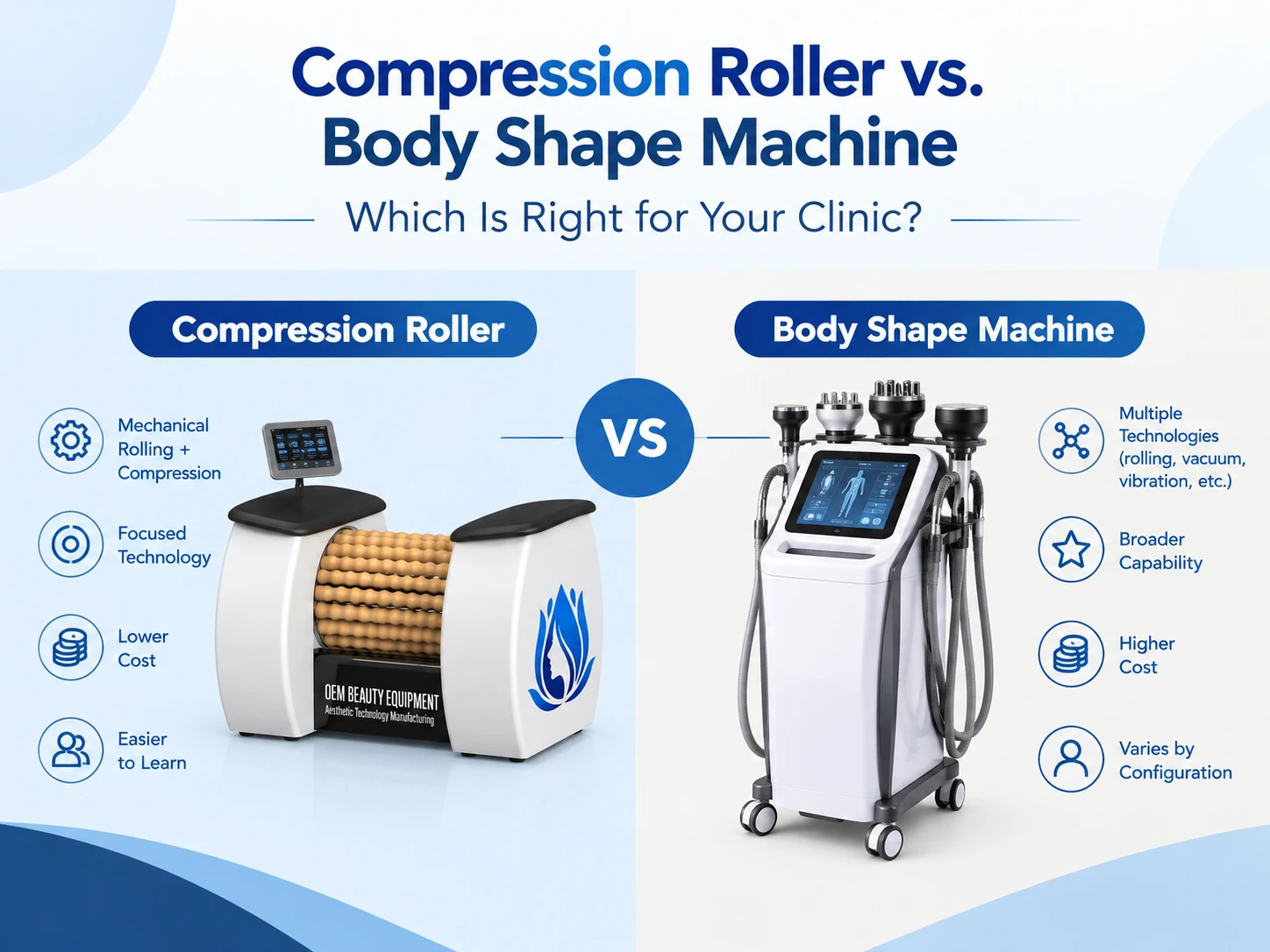
Compression Roller vs. Body Shape Machine: Which Is Right for Your Clinic?
When you’re building out a body contouring treatment menu, or sourcing equipment to sell under your own brand, two terms show up constantly in supplier catalogs: compression roller and body shape machine. On paper, they sound similar, and more than a few buyers assume they’re interchangeable. They’re not. Each uses a different mechanism, suits a different part of a treatment menu, and comes with its own sourcing considerations, from certification requirements to realistic client-facing pricing.
This guide is written for the buyer, not the end consumer. If you’re a clinic owner deciding what to add to your equipment lineup, a distributor stocking a body contouring category, or a brand owner sourcing private label devices, you need more than “how it feels for the client.” You need to understand the underlying technology well enough to evaluate suppliers, negotiate specifications, and avoid paying for capability you don’t actually need. For a broader look at how to evaluate equipment purchases generally, see our buying guide category.
What Is a Compression Roller?
A compression roller is a body contouring device built around mechanical pressure and motion. It uses motorized rollers, sometimes paired with adjustable compression settings, to apply consistent, repeated pressure across a treatment area such as the abdomen, thighs, arms, or back.
The core principle is straightforward: controlled mechanical compression combined with rolling motion is designed to work the skin and underlying tissue, support lymphatic-style drainage, and contribute to the smoother, firmer appearance clients associate with body contouring treatments.
Core Technology Behind a Compression Roller
At the hardware level, a compression roller typically includes:
- A motorized roller assembly, usually with multiple rollers working in sequence or parallel
- Adjustable pressure or compression settings, letting practitioners calibrate intensity per client and treatment area
- A control interface, ranging from simple dial controls on entry-level units to programmable digital interfaces on higher-end models
- Treatment heads or attachments sized for different body areas
Because the mechanism is primarily mechanical rather than energy-based, compression rollers generally have simpler internal electronics than RF or ultrasound devices, which can mean lower manufacturing cost, fewer components that can fail, and a shorter practitioner learning curve. That simplicity is a genuine selling point for buyers prioritizing reliability and low operating complexity over feature depth.
What Is a Body Shape Machine?
“Body shape machine” is a broader, more general term that typically refers to a body contouring device designed to address multiple concerns, body contouring, firming, and sometimes circulation support, often by combining more than one mechanism in a single unit. For general background on how non-invasive body contouring fits into the wider aesthetic treatment landscape, the American Society for Dermatologic Surgery’s overview of nonsurgical body contouring is a useful independent reference.
Where a compression roller is defined by its specific mechanical method, a body shape machine is defined by its purpose: reshaping or contouring the body’s visible appearance. In practice, this means the term can cover a wider range of underlying technologies depending on the manufacturer, including:
- Mechanical rolling and compression (overlapping with compression roller technology)
- Vacuum or suction elements
- Vibration or oscillation mechanisms
- In some models, added technologies like infrared or low-level RF
Why the Term “Body Shape Machine” Is Broader Than It Sounds
This is the single most important thing for a B2B buyer to understand: “body shape machine” is a category name, not a specific technology. When a supplier lists a product as a body shape machine, you cannot assume what’s inside it until you see the actual specification sheet. One supplier’s “body shape machine” might be functionally identical to a compression roller. Another supplier’s might combine three distinct mechanisms in one housing.
This matters enormously when you’re comparing quotes across manufacturers. Two devices with the same category label can have completely different build costs, capabilities, and client outcomes. Treat “body shape machine” as a starting point for a conversation with your supplier, not a specification in itself.
Core Differences at a Glance
| Factor | Compression Roller | Body Shape Machine |
|---|---|---|
| Defining mechanism | Mechanical rolling + compression | Varies by manufacturer; may combine rolling, vacuum, vibration, or added technologies |
| Technology specificity | Narrow, well-defined | Broad, category-level term |
| Typical complexity | Lower | Often higher, depending on included functions |
| Manufacturing cost | Generally lower | Varies widely by configuration |
| Learning curve for staff | Lower | Depends on number of functions |
| Positioning in treatment menu | Entry-level or complementary device | Can be positioned as flagship or multifunctional offering |
| Client-facing price point | Typically lower treatment price | Often priced higher, reflecting broader capability |
Treatment Capability Comparison
What a Compression Roller Is Generally Suited For
A compression roller is typically positioned for:
- Smoothing and firming treatments focused on texture rather than deeper tissue work
- Add-on services within a broader body treatment menu
- Maintenance sessions between more intensive treatments
- Entry-level body contouring offerings for clinics building out this category for the first time
What a Body Shape Machine Is Generally Suited For
Because the category is broader, a body shape machine is often positioned for:
- Flagship body contouring services, especially when the unit combines multiple mechanisms
- Clinics wanting one device to cover several treatment types rather than purchasing separate single-function machines
- Brands building a premium product line, where a multifunctional device supports a higher price point
- Distributors wanting a broader catalog entry that can be marketed to a wider range of end buyers
The Business Case: Which Should You Stock or Offer?
This is where the decision stops being about technology and starts being about your business model. There’s no universally correct answer, only the right answer for your specific position.
If You’re a Clinic Owner
Ask yourself three questions before choosing between these categories:
1. What does your current client base actually book?
If your clients are already asking for general smoothing or maintenance-style treatments, a compression roller may be the more cost-efficient entry point. If they’re asking for a more comprehensive body contouring result, a multifunctional body shape machine may justify its higher cost through a higher treatment price and stronger perceived value. Our guide to choosing a professional facial machine walks through a similar decision process that applies here too: match the device to demonstrated demand, not assumed demand.
2. What’s your available treatment room space and staff capacity?
A compression roller’s simpler mechanism generally means less staff training time and a shorter learning curve, which matters if you’re a smaller operation without a dedicated body contouring specialist on staff. A body shape machine with multiple functions needs more thorough training to use safely and effectively across all its capabilities, since undertrained staff using a feature-rich machine is a liability, not an asset.
3. What’s your realistic treatment volume?
A simpler, lower-cost compression roller can reach profitability faster on lower treatment volume. A higher-cost multifunctional body shape machine needs a clearer plan for booking volume to justify the investment within a reasonable payback period.
If You’re a Distributor
Distributors face a different calculation: category breadth versus inventory complexity.
Stocking both a compression roller and a multifunctional body shape machine gives you a wider price range to sell into, letting you serve both budget-conscious first-time clinic buyers and established clinics wanting a premium flagship device. The trade-off is more SKUs to manage, more supplier relationships to maintain, and more product-specific training your sales team needs to accurately represent each device’s actual capability, especially given how loosely “body shape machine” is used across the industry.
A practical approach many distributors take: carry one well-specified compression roller as a reliable, easy-to-sell entry point, and selectively add body shape machines from manufacturers who can clearly document exactly what mechanisms each specific model includes, rather than carrying every vaguely labeled “body shape machine” that comes through supplier outreach.
If You’re Building a Private Label Brand
For OEM/ODM buyers, the terminology problem becomes a sourcing problem. Understanding OEM vs ODM beauty equipment is the first step, but when you’re evaluating a manufacturer’s body shape machine for private labeling specifically, you need engineering-level clarity, not marketing copy, on:
- Exactly which mechanisms are included (rolling, vacuum, vibration, added technologies)
- Which components drive the unit cost, so you understand what you’re actually paying for
- Whether the manufacturer can produce a simpler, compression-roller-only variant at a lower MOQ and price point if you want to launch with a focused product before expanding your line
- How certification applies to each mechanism separately, since a device combining multiple technologies may need to meet multiple certification requirements, not just one blanket approval
Certification and Compliance Considerations
This is a point that’s easy for buyers to underweight, and expensive to get wrong. For an independent, consumer-facing perspective on why certification and safety claims matter in this category, the FDA’s consumer advisory on body contouring procedures is worth reading even as a B2B buyer, since it reflects the scrutiny your own clients may eventually bring to these questions.
A compression roller, with its simpler mechanical design, generally has a more straightforward certification path, since there’s less for a notified body or regulatory agency to evaluate. A body shape machine that combines mechanical rolling with, say, a vacuum element and an added energy-based technology may require certification coverage for each distinct mechanism, not a single certificate covering the whole unit as a package deal.
Before finalizing any purchase or private label agreement, confirm:
- Which specific certifications apply to the exact model and configuration you’re buying, not a general product family
- Whether the certification covers every function the marketing materials describe, or only some of them
- Whether your target market’s regulations treat multifunctional devices differently than single-mechanism devices
Our guide on why CE, FDA, and ISO certifications matter covers exactly how to request and verify these documents. If a supplier can’t clearly answer which certifications apply to which specific functions within a “body shape machine,” treat that as a serious red flag rather than an oversight to let slide.
Cost Structure and ROI Comparison
Typical Cost Drivers
Compression Roller
- Lower component count generally means lower manufacturing cost
- Simpler electronics reduce both unit cost and the likelihood of expensive repairs
- Lower MOQ is often achievable since the manufacturing process is less complex
Body Shape Machine
- Cost scales directly with how many mechanisms are combined
- Additional sensors, control software, and safety interlocks for multifunction units add to both unit cost and ongoing support complexity
- Higher MOQs are more common, particularly for custom configurations
Building a Realistic ROI Comparison
When comparing these two categories for your own business, build out a simple cost model rather than relying on sticker price alone:
- Total landed cost: unit price, shipping, duties, and any customization
- Expected treatment price point: what you can realistically charge per session for each device type in your market
- Expected session volume: how many treatments per week each device can realistically support
- Training and support costs: staff training time, and ongoing technical support needs
- Consumables, if any: some body shape machines use disposable attachments or accessories that add to per-treatment cost
A compression roller with a lower upfront cost and a lower price point can still outperform a more expensive body shape machine on ROI if it books consistently and needs minimal support. Conversely, a body shape machine that commands a significantly higher treatment price and strong booking demand can pay back its higher upfront cost faster than a buyer might initially assume. The decision should be driven by your specific market’s demand and your realistic volume projections, not by which device sounds more advanced on a spec sheet.
Common Mistakes B2B Buyers Make With These Categories
Assuming “Body Shape Machine” Means More Advanced
Because the term is broader, buyers sometimes assume a body shape machine is automatically a step up from a compression roller. In reality, some products labeled as body shape machines use the exact same core mechanism as a compression roller, just marketed under a broader category name. Always request the specific mechanism breakdown rather than relying on the product category label.
Not Verifying Which Specific Functions Are Certified
As covered above, certification can apply unevenly across a multifunction device’s various capabilities. Buyers who assume one certificate covers everything a product does can end up marketing unverified claims, which creates real regulatory and liability exposure.
Overbuying Capability You Won’t Use
A feature-rich body shape machine looks impressive in a sales demo, but if your client base and staff training don’t support using every function regularly, you’ve paid for capability sitting idle. Match the device to your actual, demonstrated treatment demand, not to the longest feature list available.
Underestimating Staff Training Needs
A compression roller’s simplicity is a genuine advantage if your team is small or new to body contouring services. Don’t let a flagship body shape machine’s marketing undersell how much training is actually required to use it safely and effectively across all its functions.
Skipping Supplier Verification
Whichever category you choose, the supplier matters as much as the product. Our guide on how to find a reliable beauty equipment manufacturer walks through exactly how to vet a factory, verify certifications, and request a sample before committing to a bulk order, steps that apply equally to both compression rollers and body shape machines.
A Decision Framework for Your Business
Use this checklist when evaluating which category fits your specific situation:
- Confirm the actual mechanism(s) inside any product labeled “body shape machine” before comparing it to a compression roller
- Match the device to your current client demand, not to what competitors are offering
- Calculate a realistic payback period using your actual expected treatment price and volume, not supplier-provided estimates alone
- Verify certification coverage for every function the device claims to perform
- Assess your staff’s training capacity honestly before committing to a multifunction device
- Request a sample or live demonstration before any bulk order, regardless of which category you choose
- Confirm MOQ and customization options if you’re sourcing for a private label line
Frequently Asked Questions
Is a body shape machine always more expensive than a compression roller?
Not necessarily. Because “body shape machine” is a broad category rather than a specific technology, some products labeled this way use the same core mechanism as a compression roller and are priced similarly. Price generally scales with how many distinct mechanisms the specific unit actually combines.
Can I use a compression roller for the same treatments as a body shape machine?
It depends on what the specific body shape machine includes. If it combines rolling with additional mechanisms like vacuum or vibration, a compression roller alone won’t replicate the full treatment profile. If the body shape machine is functionally equivalent to a compression roller under a different label, the treatments may be very similar.
Which is better for a new clinic entering the body contouring category?
For most new clinics, a compression roller offers a lower-cost, lower-complexity entry point with a shorter staff learning curve. Clinics with established client demand for more comprehensive body contouring may see stronger returns from a multifunctional body shape machine, provided the volume projections support the higher cost.
How do I know what’s actually inside a “body shape machine” before I buy?
Request a detailed specification sheet naming every mechanism included, not just a marketing description. Ask the manufacturer directly which technologies the device combines, and request certification documentation that corresponds to each specific function.
Can I get either device customized for a private label brand?
Yes, both categories are commonly available through OEM or ODM arrangements. A compression roller, with its simpler build, often supports a lower MOQ for customization than a more complex multifunctional body shape machine.
Do compression rollers and body shape machines need different certifications?
Potentially, yes. A compression roller’s simpler mechanism generally has a more straightforward certification path. A body shape machine combining multiple mechanisms may require certification coverage for each distinct function, so don’t assume one certificate automatically covers every capability the device offers.
What questions should I ask a supplier before ordering either device?
At minimum: what specific mechanisms are included, what certifications apply to each one, what the MOQ and lead time are, what warranty and spare parts support looks like, and whether a sample or live demonstration is available before you commit to a bulk order.
Conclusion: Choose Based on Mechanism, Not Marketing Label
The real difference between a compression roller and a body shape machine isn’t always as clean as the category names suggest. A compression roller is defined by a specific, well-understood mechanism. A body shape machine is a broader category that can range from functionally identical to a compression roller, to a genuinely multifunctional device combining several technologies.
For B2B buyers, the right move is to stop comparing category labels and start comparing actual specification sheets, certifications, and realistic ROI projections based on your specific client base and business model. Whichever category you land on, the fundamentals of smart sourcing don’t change: verify the mechanism, confirm the certifications, request a sample, and build your purchase decision around your actual demand, not the most impressive-sounding spec sheet in your inbox.