
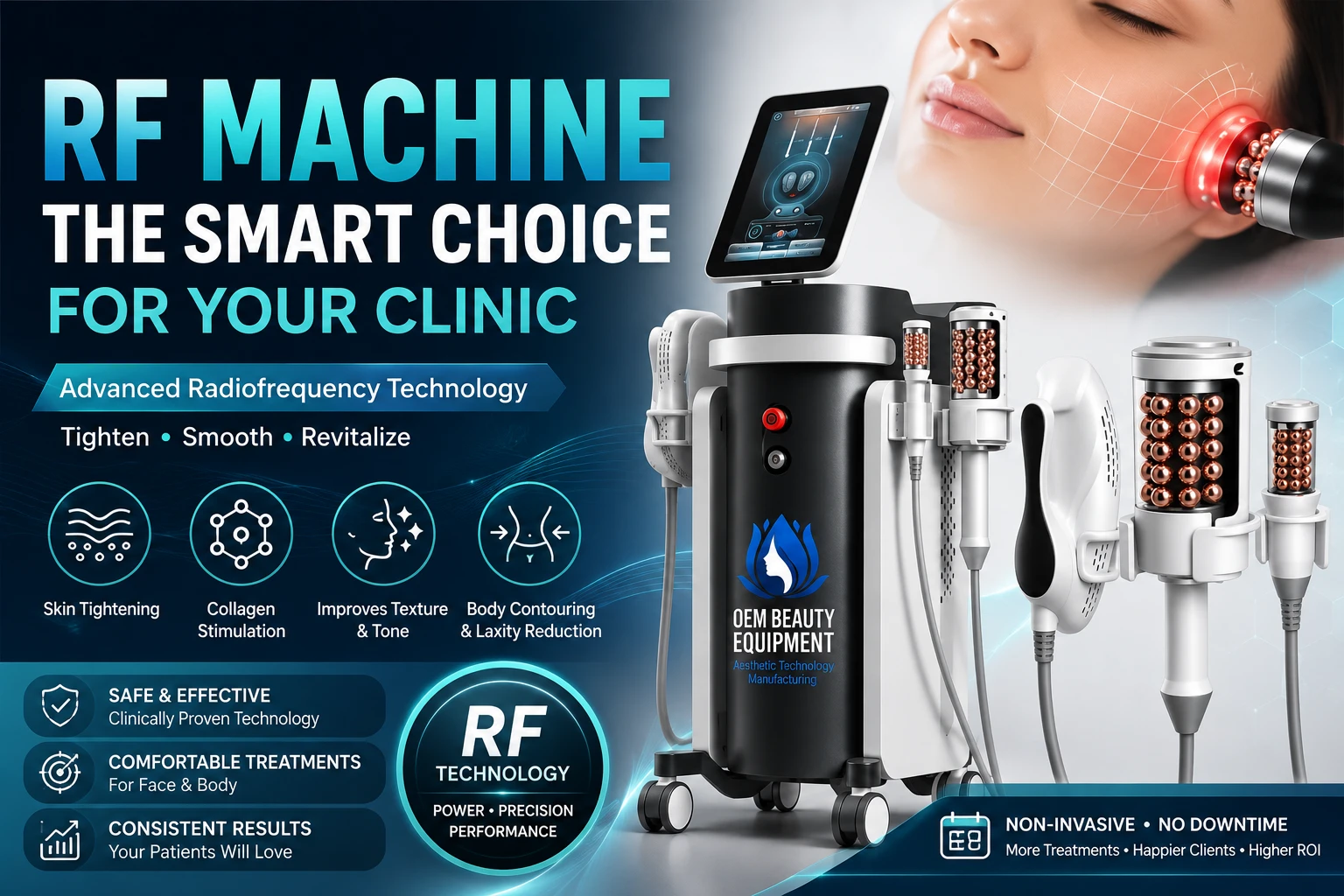
RF Machine Guide: Choosing the Right Radiofrequency Device for Your Clinic
A clinic director in Riyadh once told me she almost turned down radiofrequency treatments entirely because her first machine underperformed so badly that patients stopped booking follow-ups. It turned out the issue wasn’t the technology, it was the device. A cheaply made RF handpiece with inconsistent energy delivery had quietly undersold what radiofrequency is actually capable of. Once she switched to a properly engineered machine, the same treatment that patients had shrugged off became one of her most requested services.
That gap between a mediocre RF machine and a genuinely good one is bigger than most first-time buyers expect. Radiofrequency has been used in aesthetic medicine for over two decades now, and it remains one of the most reliable non-surgical tools for skin tightening, texture improvement, and mild laxity. But the machine you choose determines whether your clinic delivers consistent, repeatable results or spends a year fighting equipment that never quite performs the way the brochure promised.
This guide covers how RF technology actually works, what separates a professional-grade RF machine from a lower-tier import, and what to consider if you’re sourcing equipment for a clinic or building your own branded device line.
What Is an RF Machine?
An RF machine is a medical aesthetic device that uses radiofrequency energy, essentially controlled electrical current, to heat tissue beneath the skin’s surface. That heat triggers a healing response that remodels existing collagen and stimulates new collagen production, which is what produces the tightening and smoothing effect patients notice over the following weeks.
How Radiofrequency Technology Works
RF energy passes through the skin and generates heat as it meets resistance in the tissue, a principle rooted in basic electrical physics. Depending on the device design, that energy can be delivered in a monopolar, bipolar, or multipolar configuration, each distributing heat slightly differently through the dermis and subcutaneous layers.
The heat itself causes existing collagen fibers to contract immediately, which produces some of the tightening patients notice right after treatment, while the deeper, longer-lasting effect comes from the body’s wound-healing response over the following weeks as it lays down new collagen and elastin. A systematic review published in Aesthetic Surgery Journal Open Forum analyzing fifteen separate studies found consistently high patient satisfaction across RF treatments for facial rejuvenation, with the majority of participants reporting visible tightening and smoother skin texture after a course of sessions.
What Conditions Can RF Treat?
Clinics typically use RF machines for a fairly broad set of concerns:
- Mild to moderate skin laxity on the face and neck
- Skin texture and tone improvement
- Reducing the appearance of fine lines
- Body contouring and tightening after weight loss
- Post-treatment maintenance following other procedures
RF tends to work best on mild to moderate laxity rather than severe sagging, which is an important distinction to set with patients during consultation so expectations stay realistic.
Why Clinics Rely on RF Machines
RF has stayed a staple of aesthetic clinics for a reason that goes beyond marketing hype.
Patients generally find RF treatments comfortable, often described as a warm, massage-like sensation rather than the more intense feeling associated with focused ultrasound. Sessions tend to run shorter than some other energy-based treatments, which helps clinics move through a fuller daily schedule. There’s essentially no downtime, so patients can return to normal activities immediately, and because RF addresses a genuinely common concern, mild sagging and textural aging, it appeals to a wide age range rather than a narrow niche of patients seeking dramatic lifting.
For clinics, RF also pairs naturally with other treatments already on the menu. It’s common to see RF combined with microneedling, HIFU, or body contouring services as part of a layered treatment plan, which increases the average revenue per patient without requiring a completely separate consultation process.
Key Features to Look for in a Professional RF Machine
Not every RF machine on the market is built to the same standard, and the differences show up in results, not just specs.
Energy Delivery Mode
Monopolar RF reaches deeper tissue and suits body contouring and deeper facial laxity, bipolar RF is generally gentler and better suited to more superficial concerns, and multipolar configurations aim to balance depth with comfort. A quality machine often offers more than one mode so the clinic can match treatment to concern rather than owning multiple single-purpose devices.
Real Impedance Monitoring
Skin impedance changes during treatment as tissue heats, and machines with real-time impedance monitoring adjust energy output accordingly to maintain consistent, safe heating. Devices without this feedback loop risk uneven results and a higher chance of discomfort or minor burns.
Adjustable Power and Temperature Control
Operators need the ability to fine-tune both power output and target temperature for different treatment areas and skin types. A machine locked into a handful of preset programs limits how precisely a provider can tailor each session.
Handpiece Variety
Different treatment areas call for different handpiece sizes and electrode configurations. A machine offering multiple handpieces, rather than a single one-size-fits-all applicator, gives the clinic far more treatment versatility.
Cooling and Comfort Features
Integrated cooling protects the epidermis from overheating and significantly improves patient comfort, particularly during longer or higher-energy sessions.
Build Quality and Component Sourcing
The internal components, particularly the RF generator and control board, determine how consistent energy delivery stays over years of daily clinical use. Machines built with lower-grade components tend to drift out of calibration faster, which quietly erodes treatment quality long before the device visibly breaks down.
This is a detail that rarely shows up in a product demo, since a brand new machine tends to perform well regardless of component quality. The real test comes twelve to eighteen months in, when a well built generator still delivers the same precise output it did on day one, while a cheaper unit starts requiring more passes to achieve the same result. Asking a supplier directly about the brand and origin of their core electronic components is a reasonable question, and hesitation to answer it is worth noting.
RF Machine Specifications That Matter
Here’s what to actually compare when reviewing spec sheets from different suppliers.
| Specification | Why It Matters |
|---|---|
| RF Mode | Monopolar, bipolar, or multipolar determines treatment depth and sensation |
| Frequency | Affects how energy distributes through tissue |
| Power Output | Determines treatment strength and session efficiency |
| Handpiece Options | More options mean broader treatment applications |
| Impedance Monitoring | Ensures consistent, safe energy delivery |
| Cooling System | Protects skin and improves comfort during longer sessions |
| Display/Interface | Affects training time and ease of daily use |
A machine with an impressive maximum power rating but weak impedance monitoring can still produce inconsistent results in practice. Numbers on a spec sheet only tell part of the story, so ask suppliers for real clinical demonstration footage or references from existing clinic customers whenever possible.
RF Machine vs HIFU Machine: Which Should Your Clinic Choose?
This comparison comes up constantly, and the honest answer is that most established clinics eventually offer both rather than picking one over the other.
| Comparison | RF Machine | HIFU Machine |
|---|---|---|
| Treatment Depth | Dermis, shallower tissue layers | Reaches SMAS layer, deeper structural tissue |
| Best Applications | Mild laxity, texture, tone | Deeper lifting, jawline and neck contouring |
| Patient Experience | Warm, generally comfortable | More intense sensation, brief discomfort |
| Results Onset | Often visible sooner | Builds gradually over 2 to 3 months |
| Session Frequency | More frequent maintenance sessions | Longer intervals between treatments |
| Cost Per Session | Generally lower | Generally higher, premium positioning |
If your patient base skews younger with early signs of laxity, RF alone may cover most of your needs. For more established sagging or jawline concerns, HIFU tends to deliver more noticeable structural lift. If you’re weighing this decision for your own treatment menu, our detailed breakdown of HIFU machines for professional clinics covers that technology in depth alongside this comparison.
Certifications Every Professional RF Machine Should Have
Certifications aren’t optional paperwork, they’re the proof that a device has actually been tested against recognized safety benchmarks, and in most countries they’re a legal requirement before a clinic can use the machine on patients.
For clinics operating in the European Economic Area, CE marking, overseen through the European Medicines Agency’s medical device framework, confirms a device has passed a conformity assessment covering safety and performance requirements. In the United States, manufacturers and distributors should appear on the FDA’s device registration and listing records before commercial distribution. For quality management specifically, ISO 13485 certification confirms the manufacturer has documented, auditable processes covering design, production, and post-market monitoring rather than a one-time inspection.
You can review the certifications we maintain across our product range on our certification page, and our earlier piece on why CE, FDA, and ISO certifications matter when buying beauty equipment goes deeper into what each one actually verifies.
How to Choose an RF Machine Manufacturer
The device matters, but the manufacturer behind it determines what your ownership experience actually looks like once the machine is running daily treatments.
Manufacturing experience specifically in energy-based aesthetic devices tends to translate into fewer design flaws and more refined engineering than a factory still building out its first few product generations. In-house research and development capability means the manufacturer can adapt, troubleshoot, and improve the platform rather than simply reselling a design they don’t fully understand. Documented quality control, ideally backed by ISO 13485 certification, tells you whether consistency is built into every production run or left to chance.
Ask specifically about technical support structure, since a manufacturer offering remote diagnostics and responsive troubleshooting saves enormous time compared to one that requires shipping the entire unit back overseas for repairs. Warranty terms should be confirmed in writing, including what voids coverage, and spare parts availability matters just as much two years after purchase as it does on day one. Training format, whether on-site, video-based, or documentation only, also affects how quickly your staff can start delivering consistent treatments.
It’s also worth asking how the manufacturer handles firmware or software updates over the life of the device. Aesthetic technology continues to evolve, and a manufacturer that periodically refines treatment protocols or adds new presets through software updates extends the useful life of a machine well beyond what the original purchase price might suggest. A manufacturer with no update pathway at all is effectively selling you a device frozen at its launch specification.
OEM RF Machines for Clinics and Beauty Brands
For clinics scaling into their own equipment line, or distributors and beauty brands looking to enter the aesthetic device market, an OEM beauty equipment manufacturer can build RF machines customized around your brand rather than reselling a generic, unbranded unit.
Customization typically extends to housing design and color, branding and logo placement, touchscreen interface and language localization, included handpiece sets, and packaging built for your specific market. Working from an existing, proven RF platform significantly reduces development cost and time to market compared to engineering a device from scratch, while still giving your brand full ownership of the customer-facing product. If you’re weighing whether to customize an existing platform or commission something fully bespoke, our comparison of OEM vs ODM beauty equipment manufacturing explains the practical difference between the two paths.
Common Mistakes When Buying an RF Machine
Most disappointing RF purchases trace back to a handful of avoidable decisions.
Choosing based purely on the lowest quote tends to be the most expensive mistake over time, since the savings rarely account for weaker components or poor after-sales support. Skipping verification of certifications is a close second, especially when a device “looks professional” without any documentation to back it up. Ignoring impedance monitoring capability leads to inconsistent treatment quality that patients notice even if staff can’t immediately pinpoint why. Buying without confirming spare parts availability creates a real problem the first time a handpiece or generator component needs replacing. And choosing a single-mode device without considering the full range of concerns your patient base actually presents limits your treatment menu sooner than expected, often forcing an unplanned upgrade within the first year or two.
One less obvious mistake worth mentioning is underestimating staff training. Even a well engineered RF machine can deliver mediocre results in the hands of a poorly trained operator, since energy settings, handpiece technique, and treatment pacing all affect the outcome. Clinics that invest time in proper training alongside the equipment purchase tend to see far more consistent patient satisfaction than clinics that treat training as an afterthought.
Frequently Asked Questions About RF Machines
What is an RF machine used for in aesthetics?
An RF machine uses radiofrequency energy to heat tissue beneath the skin, stimulating collagen production for skin tightening, texture improvement, and mild laxity correction on the face and body.
Is RF better than HIFU for skin tightening?
Neither is universally better. RF suits milder laxity and surface texture with a more comfortable treatment experience, while HIFU reaches deeper structural tissue for more noticeable lifting. Many clinics offer both to cover a wider range of patient concerns.
How many RF sessions are usually needed to see results?
Most protocols involve a series of four to six sessions spaced one to two weeks apart, with some visible tightening after the first session and fuller results developing as new collagen forms over the following months.
What certifications should a professional RF machine have?
At minimum, look for CE certification for the European market, FDA registration for the U.S. market, and ISO 13485 certification confirming the manufacturer’s quality management system meets recognized medical device standards.
Can RF machines be customized for a private label brand?
Yes. Established OEM manufacturers can customize housing design, branding, interface, handpiece sets, and packaging on proven RF platforms, allowing brands to launch a private-labeled device without building the underlying technology from scratch.
What is the difference between monopolar, bipolar, and multipolar RF?
Monopolar RF reaches deeper tissue and suits body contouring, bipolar RF is generally gentler and better for superficial concerns, and multipolar configurations aim to balance treatment depth with patient comfort.
Final Thoughts
Radiofrequency remains one of the most dependable, patient-friendly technologies in aesthetic medicine, but only when the machine behind the treatment is genuinely built to a professional standard. Prioritize real specifications over marketing claims, confirm certifications with actual documentation, and vet the manufacturer’s track record on support and spare parts before committing to a purchase.
If you’re exploring a professional RF machine for your clinic, or considering an OEM partnership to build your own branded device line, our team can walk through the right configuration for your treatment goals. Contact us to discuss your requirements, or explore our full OEM and ODM manufacturing capabilities to see what’s possible.