
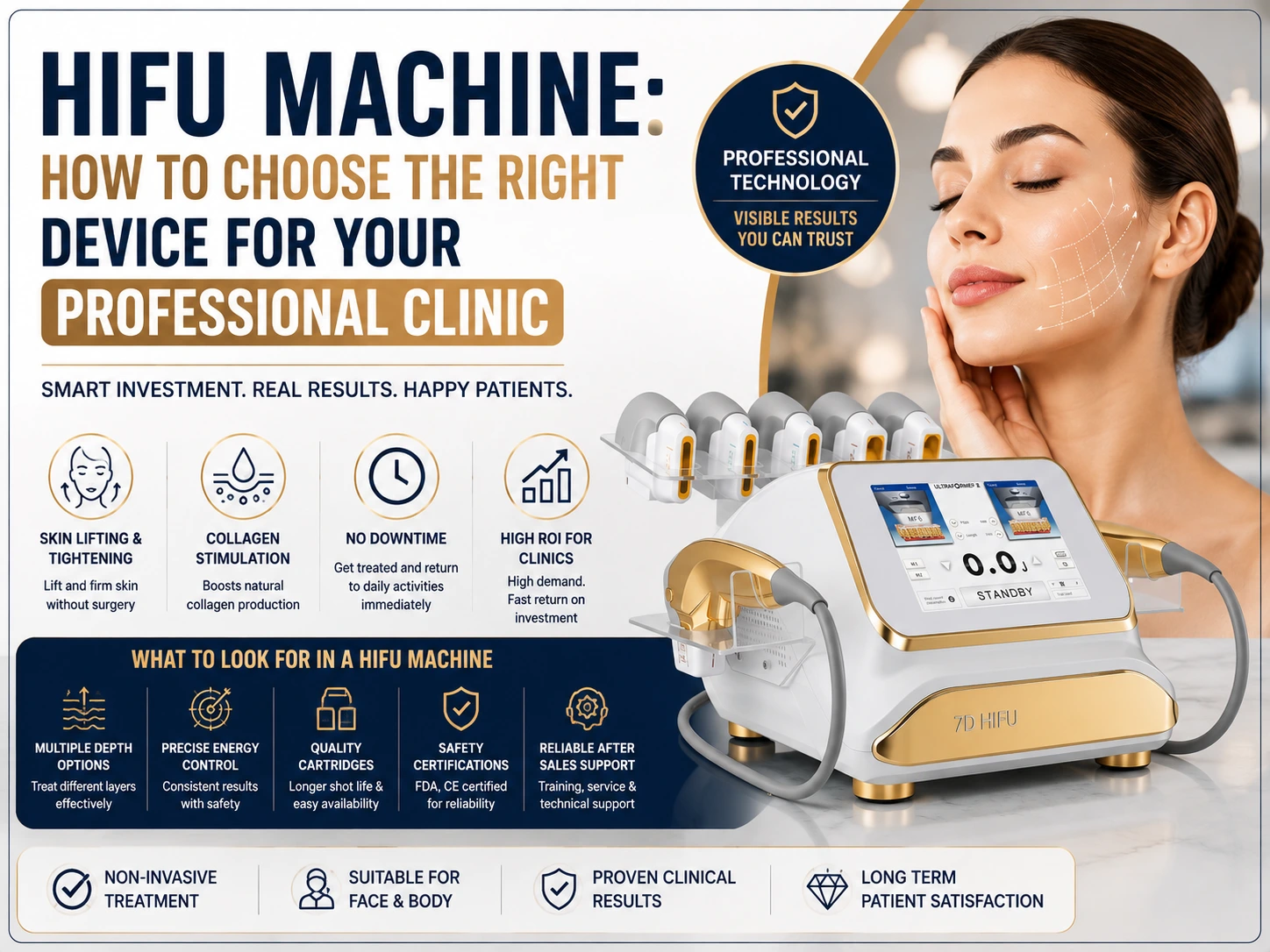
HIFU Machine: How to Choose the Right Device for Your Professional Clinic
A few years ago, a distributor I spoke with in Southeast Asia described his first HIFU purchase as “buying a car by looking at the paint job.” He picked the machine with the shiniest touchscreen and the most confident sales rep, then spent the next year fighting cartridge shortages and a warranty that turned out to be more of a suggestion than a policy. He got there eventually, but the expensive way.
A HIFU machine is a high intensity focused ultrasound device used in aesthetic clinics to lift and tighten skin without surgery. It has become one of the most requested treatments in the aesthetic industry, and the reason is straightforward: patients get visible, natural-looking results with none of the downtime that comes with a scalpel. But choosing the right device for a professional clinic involves more than comparing price tags on a spec sheet.
This guide breaks down how HIFU technology actually works, what separates a genuinely professional-grade machine from an imitation, and what you need to know if you are considering an OEM HIFU machine to build a brand of your own.
What Is a HIFU Machine?
In plain terms, a HIFU machine delivers High Intensity Focused Ultrasound energy to a precise point beneath the skin. Unlike lasers or radiofrequency, which work at or near the surface, HIFU can reach the same structural tissue layer that surgeons address in a facelift, without cutting anything.
How Does HIFU Technology Work?
The device concentrates ultrasound waves into a tight focal point, much like sunlight passing through a magnifying glass concentrates into a single burning spot. That focal point sits at a specific depth under the skin, commonly the SMAS layer, and heats tissue there to a temperature that triggers controlled thermal injury.
That controlled injury is the whole point. It signals the body to produce fresh collagen and elastin over the following weeks, which is why HIFU results build gradually rather than appearing immediately. Because the energy focuses below the surface, the skin itself experiences minimal disruption, which is what makes HIFU a genuinely non-invasive treatment rather than a surface-level one.
What Is HIFU Used For?
Clinics generally offer HIFU for:
- Skin tightening across the face and body
- Facial lifting, particularly the mid and lower face
- Jawline definition and contouring
- Neck treatments for sagging or loose skin
- Softening fine lines and wrinkles
Clinical evidence supports several of these uses. A retrospective study published through NCBI’s PMC repository found that combining HIFU with radiofrequency led to clinically significant improvement in the vast majority of treated patients, with mild, short-lived redness as the primary side effect. That’s the kind of documented outcome worth asking your supplier about directly.
Why Are HIFU Treatments Popular in Professional Clinics?
The non-surgical approach appeals to patients who want a lifted, tighter appearance without the recovery time, cost, or risk of surgery. Sessions typically involve minimal downtime, so patients can book an appointment and return to normal activities the same day. Demand for this kind of aesthetic treatment has grown steadily across nearly every region as patients look for alternatives to invasive procedures.
HIFU also offers real treatment versatility, since a single platform can often address the face, jawline, neck, and in some configurations the body, which means a clinic doesn’t need three separate machines to cover those concerns. And for clinic owners specifically, it represents a genuine business opportunity. A well-utilized machine, priced correctly, typically pays for itself faster than most other aesthetic equipment categories, since sessions command a premium and encourage repeat bookings over the following months.
What Should You Look for in a Professional HIFU Machine?
This is the part that actually determines whether your purchase works out. Spec sheets tend to blur together, so here’s what genuinely separates devices.
Treatment Depth Options
Different treatment areas need different depths. Superficial skin around the eyes calls for a shallow 1.5mm to 3mm cartridge, while deeper facial and neck tightening typically needs 4.5mm, and body applications can require cartridges going as deep as 13mm. A machine that only offers one or two depth options limits what your clinic can realistically treat.
Energy Control and Precision
Adjustable energy settings let the operator tailor treatment strength to the patient’s skin thickness, pain tolerance, and treatment goal. Accurate, consistent energy delivery at each shot is what separates predictable results from a treatment that feels more like guesswork.
HIFU Cartridges
Cartridges deserve more attention than most buyers give them. Ask about the available depth range, how many shots each cartridge delivers before replacement, whether replacements are readily available or require long shipping waits, and how much flexibility that gives your treatment menu. A machine can look impressive on paper and still become a liability if cartridges are hard to source six months after purchase.
User-Friendly Interface
A clear touchscreen with logical treatment settings shortens staff training time and reduces the chance of a setting being entered incorrectly mid-treatment. This matters more in a busy clinic with rotating staff than it might seem during a demo.
Safety Features
Built-in safety systems, including automatic energy calibration and shutoff protections, reduce risk for both the patient and the clinic. Controlled energy delivery is not a bonus feature, it’s the baseline requirement for a device you are willing to put your name behind.
Handpiece Design
An ergonomic, well-balanced handpiece reduces strain on the operator during longer sessions and tends to improve consistency across a full day of back-to-back appointments.
HIFU Machine Specifications That Matter
Use this as a working checklist when comparing devices, and ask suppliers to fill in real numbers rather than vague claims.
| Specification | What to Check |
|---|---|
| Frequency | Determines how deep the energy penetrates |
| Energy Output | Affects treatment strength and number of passes needed |
| Treatment Depth | Should span shallow to deep cartridge options |
| Cartridge Options | Number of interchangeable depths available |
| Shot Count | Total shots delivered per cartridge |
| Cartridge Lifespan | Directly impacts your ongoing running costs |
| Display/Interface | Clarity and ease of staff training |
| Power Requirements | Relevant if running multiple devices in one clinic |
| Safety Features | Automatic shutoff, calibration checks, overheat protection |
If you’re evaluating a specific unit, ask the manufacturer to provide these numbers in writing rather than relying on marketing brochures. A supplier confident in their product will not hesitate.
HIFU Machine vs Other Skin Tightening Technologies
HIFU rarely operates in isolation. Most clinics are also weighing it against, or alongside, other energy-based technologies.
HIFU vs RF Skin Tightening
HIFU uses focused ultrasound to reach deep structural tissue, while radiofrequency uses electrical current to heat the dermis at a shallower level. HIFU tends to suit deeper lifting and contouring, while RF is often chosen for surface texture, mild laxity, and a more comfortable patient experience. Many established clinics run both, since the treatments complement rather than replace each other.
HIFU vs Ultrasound Skin Tightening
This distinction confuses a lot of buyers, understandably, since both use the word ultrasound. Standard cosmetic ultrasound devices deliver diffuse, low-intensity energy across the skin surface without concentrating it at a specific depth. HIFU, by contrast, focuses high-intensity energy into a tight point at a chosen depth, which is what allows it to reach the SMAS layer and trigger the thermal response needed for lifting. The shared terminology hides a meaningful technical gap between the two.
Which Technology Is Right for Your Clinic?
There isn’t a universal answer here, and any supplier who tells you HIFU is objectively “better” than RF or vice versa is oversimplifying. The right technology depends on your target patient base, the treatment menu you’re building, your budget, and the results you can realistically deliver with your staff’s current training. Our guide on choosing the best professional facial machine walks through this decision across several technology types, not just HIFU.
HIFU Facial Machine vs Professional Multi-Functional Systems
Another decision point clinics run into is whether to buy a dedicated HIFU facial machine or a multi-functional platform that combines HIFU with RF, cavitation, or other modalities.
Dedicated facial systems tend to be optimized specifically for face and neck work, often with more refined cartridge options for that use case. Multi-functional platforms trade some of that specialization for broader treatment flexibility, letting a clinic offer several services from a single footprint. That decision usually comes down to your available clinic space, budget, and expected treatment volume. A high-volume clinic doing dozens of HIFU sessions weekly may benefit more from a dedicated system, while a smaller clinic still building its service menu might get more value from a multi-functional device.
How to Choose a HIFU Machine for Your Business
Once you understand the technology, the actual buying process comes down to a fairly disciplined checklist.
Define Your Treatment Requirements
Decide upfront which areas and concerns you want to treat, since that determines the cartridge range and depth options you actually need.
Check Product Certifications
Confirm CE, FDA, ISO 13485, and any regional certifications relevant to where you operate. Ask for documentation, not just logos.
Evaluate Cartridge Availability
Confirm lead times for replacement cartridges before you commit. A machine that’s out of cartridges for six weeks is a machine that’s not generating revenue.
Compare Manufacturer Support
Ask specifically what technical support looks like when something goes wrong. Remote troubleshooting is very different from shipping a machine back overseas.
Consider Warranty and Spare Parts
Get warranty terms in writing, including what voids coverage, and confirm how long spare parts remain available after the warranty period ends.
Review Training and Technical Support
Confirm what training is included, in what format, and whether it covers both operation and basic troubleshooting.
Calculate Long-Term Operating Costs
Purchase price is only part of the equation. Factor in cartridge costs, shipping, and expected maintenance over a realistic multi-year period, since a cheaper machine with expensive consumables can end up costing more.
As for price itself, professional HIFU machines vary enormously depending on configuration, brand, and certification level, and buyers commonly see quotes anywhere from a few thousand dollars for a factory-direct entry-level system up to tens of thousands for premium, established-brand platforms. Rather than chasing the lowest number, it’s worth calculating a realistic break-even point based on your expected treatment volume and per-session pricing.
Why the Manufacturer Matters When Buying a HIFU Machine
The device is only half the purchase. The manufacturer behind it determines what happens after the invoice is paid.
Manufacturing experience matters because a factory that has built aesthetic devices for a decade or more has usually already solved the engineering problems newer factories are still discovering. In-house R&D capability signals that the manufacturer can adapt and troubleshoot rather than simply reselling a design they don’t fully understand. Quality control processes, ideally backed by documented certifications like ISO 13485, tell you whether consistency is built into the production line or left to chance.
International distribution experience means the manufacturer has already navigated FDA, CE, and other regional requirements for other clients, which saves you significant time. And warranty, technical support, and spare parts availability are the practical, unglamorous details that determine whether a small issue two years from now becomes a minor inconvenience or a serious operational headache. This is the point in the buying process where informational research turns into an actual purchasing decision, and it’s worth slowing down here rather than rushing to a signature.
OEM HIFU Machine: Build Your Own Aesthetic Equipment Brand
For beauty brands, distributors, medical spas, aesthetic equipment companies, and entrepreneurs looking to go beyond simply buying a machine, an OEM HIFU machine opens up a different kind of opportunity. Instead of reselling someone else’s brand, you put your own name on a device engineered to your specifications.
What Can Be Customized?
Depending on your manufacturing partner and order volume, customization can typically extend to:
- Logo and branding across the device and marketing materials
- Device housing color and design
- Software and user interface elements
- Packaging design
- User manuals in your language and tone
- Included accessories and cartridge sets
This is where working with an experienced OEM beauty equipment manufacturer genuinely pays off, since the depth of customization available depends heavily on the manufacturer’s engineering capability, not just their willingness to slap a new logo on an existing shell.
OEM vs ODM HIFU Machine: What's the Difference?
These two terms get used interchangeably by buyers, but they describe genuinely different manufacturing relationships.
OEM HIFU Manufacturing
Original Equipment Manufacturing typically means an existing, proven device platform gets customized around your brand, from housing to interface to accessory sets. It’s a faster route to market than building something from scratch.
ODM HIFU Manufacturing
Original Design Manufacturing goes a step further, involving custom product development and engineering work tailored specifically to your requirements. This takes longer and usually costs more, but it produces a genuinely differentiated device rather than a rebranded existing model.
Which Model Is Right for Your Business?
If budget and development time are tight, OEM customization on an existing platform is usually the smarter starting point. If you need a genuinely unique product to differentiate in a competitive market and have the budget and timeline to support it, ODM gives you that control. Our detailed comparison of OEM vs ODM beauty equipment manufacturing breaks this down further if you’re still weighing the two paths.
Common Mistakes to Avoid When Buying a HIFU Machine
Choosing purely based on price tends to be the costliest mistake long-term, since the savings upfront rarely account for cartridge availability or support down the road. Ignoring certifications is a close second, often because “it looks professional” gets mistaken for “it’s certified.” Not checking cartridge quality leads to inconsistent results that patients notice even if staff don’t immediately connect the dots. Buying without after-sales support turns a routine technical issue into weeks of downtime. Not verifying the manufacturer, meaning skipping due diligence on their actual track record, leaves clinics exposed if the relationship sours. Ignoring spare-part availability creates the same problem months later when something inevitably needs replacing. And choosing a technology without honestly considering the clinic’s actual treatment needs results in an expensive machine that doesn’t match the patients walking through the door. Our related piece on common mistakes when starting a beauty equipment business covers several of these from a broader sourcing perspective too.
HIFU Machine Buying Checklist
Print this, save it, or hand it to whoever is running point on your purchasing decision.
- Treatment depths available across cartridges
- Adjustable energy settings
- Cartridge options and realistic shot counts
- CE, FDA, ISO 13485, and other relevant certifications
- Warranty terms in writing
- Spare parts availability and lead times
- Training format and depth included with purchase
- Ongoing technical support structure
- Manufacturer’s track record and experience
- OEM/ODM availability if branding matters to you
Frequently Asked Questions About HIFU Machines
What is a HIFU machine?
A HIFU machine is a medical aesthetic device that uses High Intensity Focused Ultrasound to heat tissue at a specific depth beneath the skin, typically the SMAS layer, to stimulate collagen production and produce a non-surgical lifting and tightening effect.
What is HIFU treatment used for?
HIFU is primarily used for skin tightening, facial and neck lifting, jawline contouring, and softening fine lines and wrinkles, without surgery or significant downtime.
What should I look for when buying a HIFU machine?
Prioritize treatment depth options, cartridge availability and lifespan, real certifications like CE, FDA, and ISO 13485, adjustable energy control, and a manufacturer with a proven track record for after-sales support.
How much does a professional HIFU machine cost?
Pricing varies significantly based on brand, cartridge configuration, and certification level, with factory-direct entry-level systems typically starting in the low thousands and premium, established-brand platforms reaching well into the tens of thousands. Calculating a realistic break-even point based on expected treatment volume matters more than chasing the lowest sticker price.
What certifications should a HIFU machine have?
At minimum, look for CE certification for European markets, FDA registration for the U.S. market, and ISO 13485 certification for quality management specific to medical devices.
What is the difference between HIFU and RF skin tightening?
HIFU uses focused ultrasound to reach deeper structural tissue like the SMAS layer, while RF uses electrical energy to heat the dermis at a shallower depth. HIFU generally suits deeper lifting, while RF suits surface texture and milder laxity.
Can I buy a HIFU machine with my own brand?
Yes. Many manufacturers offer OEM services allowing you to customize branding, housing design, software, and packaging on an existing platform, which is typically faster and more affordable than fully custom ODM development.
What is the difference between OEM and ODM HIFU machines?
OEM involves customizing an existing device platform around your brand, while ODM involves custom engineering and product development tailored specifically to your requirements. OEM is faster and cheaper, ODM offers deeper differentiation.
Final Thoughts: Choosing the Right HIFU Machine
Working through this decision properly means moving through the right order: understand the technology, check the specifications honestly, confirm the safety features, verify the certifications, vet the manufacturer, lock down the support terms, and only then weigh the long-term value against the purchase price. Skip a step and it tends to resurface later, usually at an inconvenient moment with a fully booked appointment calendar.
Looking for a reliable OEM HIFU machine for your beauty equipment brand? Explore our OEM and ODM solutions or contact our team to discuss your requirements.