
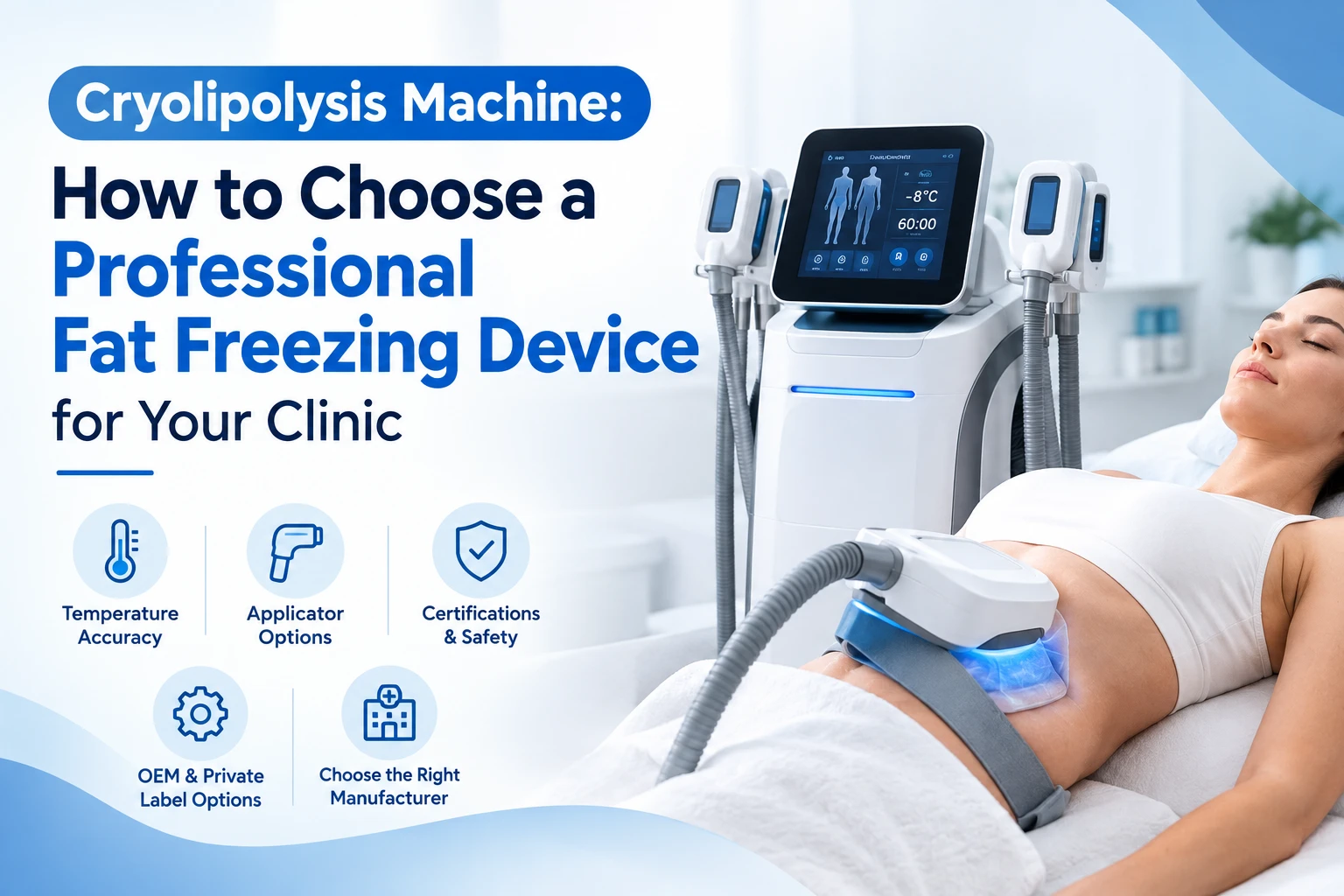
Cryolipolysis Machine: How to Choose a Professional Fat Freezing Device for Your Clinic
A distributor I spoke with in Johannesburg once explained why he switched cryolipolysis suppliers twice in eighteen months. The first machine ran hot, literally, drifting a few degrees above its target temperature during longer sessions, which meant treatments that should have taken sixty minutes stretched closer to ninety while staff babysat the display. The second supplier fixed the temperature problem but couldn’t keep applicators in stock. By the time he found a manufacturer who got both right, he’d already burned through a year of inconsistent bookings and frustrated clients.
Fat freezing has quietly become one of the most requested non-surgical body contouring treatments in aesthetic medicine, and the demand keeps climbing. It’s non-invasive, it requires no anesthesia, and it targets a concern almost every clinic’s patient base shares in some form, stubborn fat that doesn’t respond to diet or exercise. But as that distributor’s story shows, the technology’s reputation for reliability depends entirely on the machine delivering it.
This guide breaks down how cryolipolysis actually works, what separates a genuinely professional-grade fat freezing machine from a cheaper import, and what to look for whether you’re equipping a single clinic or building an OEM device line.
What Is a Cryolipolysis Machine?
Cryolipolysis is the clinical name for the technology; fat freezing is the term patients usually recognize. A cryolipolysis machine uses controlled, precisely regulated cooling to target subcutaneous fat cells beneath the skin, causing them to break down and eventually get cleared from the body through natural metabolic processes over the following weeks.
It’s worth noting that CoolSculpting is a specific branded system built on this underlying technology, not the technology itself, similar to how “Kleenex” refers to one brand of a broader product category. Understanding that distinction matters both for accurate marketing and for setting correct expectations with patients who may only be familiar with the branded name.
How Cryolipolysis Technology Works
The principle behind cryolipolysis is that fat cells are more sensitive to cold than the surrounding skin, muscle, and connective tissue. When an applicator holds tissue at a specific low temperature for a set duration, typically using vacuum suction or contact plates to draw the treatment area into position, fat cells within that zone crystallize and undergo a controlled cell death process. The body’s own immune system then gradually clears those damaged cells over the following eight to twelve weeks.
The technology has a long clinical track record at this point. A retrospective patient satisfaction study published through NCBI’s PMC repository reviewing an FDA-cleared cryolipolysis system found consistently high satisfaction and recommendation rates among treated patients, with most citing the lack of anesthesia, no surgical scarring, and minimal recovery time as their primary reasons for choosing the treatment.
What Areas Can Cryolipolysis Treat?
Clinics typically use cryolipolysis machines for:
- Abdominal fat reduction
- Flank and love handle contouring
- Thigh and inner thigh treatment
- Submental fat, meaning the area under the chin
- Upper arm and back fat
- Bra fat and banana roll areas beneath the buttocks
Coverage varies by applicator design and machine configuration, which is part of why applicator versatility matters so much when comparing devices, a point worth returning to later in this guide.
Why Clinics Invest in Cryolipolysis Machines
Non-surgical body contouring has grown into one of the most requested procedure categories in aesthetic medicine, and cryolipolysis sits at the center of that growth for a few clear reasons.
Patients are drawn to it because it requires no anesthesia, no incisions, and essentially no downtime, so someone can complete a session during a lunch break and return to normal activity immediately afterward. Results develop gradually and look natural rather than sudden, since the body needs weeks to clear the treated fat cells, which tends to produce outcomes that read as genuine changes to the body rather than an obviously artificial intervention.
For clinics, the appeal extends into the business side as well. A single treatment area can require multiple applicator cycles or a series of sessions, which builds recurring bookings similar to other energy-based treatments. And because cryolipolysis addresses a genuinely universal concern, stubborn fat pockets that resist diet and exercise, it draws a wide range of patients rather than a narrow niche audience, which helps fill appointment calendars across different demographics.
The category has also matured to a point where patient awareness works in a clinic’s favor. Most prospective patients researching body contouring options have already heard the term “fat freezing” or recognize the branded name CoolSculpting, which shortens the education curve during consultation compared to newer or less familiar technologies. A clinic simply needs to explain how their specific professional-grade device compares, rather than introducing the entire concept from scratch.
Key Features to Look for in a Professional Cryolipolysis Machine
Not every machine marketed for fat freezing meets a genuinely professional clinical standard. Here’s what actually separates a reliable device from a risky one.
Precision Temperature Control
Accurate, stable temperature control throughout the full treatment cycle is the single most important factor in cryolipolysis performance. A machine that drifts even a few degrees off target can undertreat tissue, producing weaker results, or overtreat it, increasing the risk of skin damage. Look for digital temperature monitoring with a genuinely tight, verifiable tolerance range rather than a display that simply shows a target number without confirming it’s actually being maintained.
Applicator Configuration and Coverage
Multiple applicator sizes and shapes allow a clinic to treat a wider range of body areas, from larger zones like the abdomen to smaller, more precise areas like the submental region. Multi-applicator systems that support two or more simultaneous treatments also improve clinic efficiency considerably, since a single patient visit can address more than one area per session.
Vacuum Suction Strength and Consistency
Consistent, well-calibrated vacuum suction keeps tissue properly positioned against the cooling plates throughout the full treatment duration. Inconsistent suction leads to uneven cooling contact, which directly affects how uniform the final results look.
Cooling Plate Design
Surround or 360-degree cooling designs generally provide more uniform contact and coverage than older flat-plate designs, which can leave gaps in coverage at the treatment area’s edges.
Safety Sensors and Automatic Shutoff
Built-in sensors that continuously monitor temperature and automatically halt treatment if levels move outside a safe range protect both the patient and the clinic’s liability exposure. This should be treated as a non-negotiable feature, not an upgrade option.
Session Timer and Protocol Presets
A clear, accurate session timer combined with adjustable protocol presets for different treatment areas reduces the chance of operator error and helps standardize results across staff members of varying experience levels.
Cryolipolysis Machine Specifications That Matter
| Specification | Why It Matters |
|---|---|
| Temperature Range | Determines treatment flexibility across different tissue types and areas |
| Temperature Accuracy | Directly affects both safety and treatment effectiveness |
| Number of Applicators | More applicators mean broader treatment area coverage |
| Simultaneous Treatment Capability | Affects clinic efficiency and daily patient throughput |
| Vacuum Suction Level | Impacts tissue contact consistency during treatment |
| Session Duration Control | Should allow protocol customization by treatment area |
| Safety Sensors | Automatic monitoring and shutoff protect patients and reduce liability |
Ask suppliers for the actual documented temperature accuracy tolerance, not just a stated range. A machine claiming a wide temperature range with poor accuracy control is a very different product from one with a narrower range held to a tight, verified tolerance.
Certifications Every Professional Cryolipolysis Machine Should Have
Cryolipolysis carries a genuine clinical risk profile if temperature control fails, which makes certification and documented safety testing especially important in this category.
For clinics operating in the United States, confirm that the device or its underlying technology aligns with recognized FDA guidance on non-invasive body contouring technologies, and that the specific manufacturer is properly registered. For the European market, CE certification confirms the device has passed a conformity assessment covering safety and performance. Beyond regional clearance, ISO 13485 certification confirms the manufacturer follows a documented, auditable quality management system rather than relying on a one-time inspection. You can review the certifications maintained across our own device range on our certification page.
It’s also worth being aware of paradoxical adipose hyperplasia, a rare but documented complication where treated fat tissue paradoxically increases rather than decreases. It remains uncommon, but its existence in the clinical literature is exactly why device precision and proper patient screening matter so much in this treatment category, and why cutting corners on machine quality carries real downstream risk.
How to Choose a Cryolipolysis Machine Manufacturer
The device is only half of the purchasing decision. The manufacturer behind it determines what your ownership experience actually looks like once the machine is running daily sessions.
Manufacturing experience specifically in cooling-based aesthetic technology matters, since temperature regulation engineering is a genuinely different discipline than the engineering behind laser or RF devices. Ask how long the manufacturer has specifically produced cryolipolysis systems.
In-house research and development capability signals that the manufacturer can refine cooling calibration and applicator design over time rather than simply reselling a static, unchanging design. Documented quality control, ideally backed by ISO 13485 certification, tells you whether consistency is engineered into every unit or left to chance during assembly.
Confirm technical support structure directly, since temperature calibration issues are exactly the kind of problem that benefits from responsive remote diagnostics rather than shipping an entire machine back overseas. Warranty terms should be confirmed in writing, and applicator availability deserves particular attention, since applicators are the component most likely to need replacement over a machine’s working life, and a manufacturer with poor applicator stock can leave a clinic unable to deliver a core service for weeks at a time.
It’s also worth asking how the manufacturer validates temperature accuracy before a unit ships, not just during initial design testing. A single validated prototype tells you very little about consistency across a full production run, so ask whether every unit undergoes calibration testing individually or whether quality control relies on periodic sampling instead. For a technology this dependent on precise temperature control, that distinction is worth pushing on rather than accepting a vague answer.
OEM Cryolipolysis Machines for Clinics and Beauty Brands
For distributors, medspa groups, and beauty brands looking to build a device line rather than resell a generic unit, an OEM beauty equipment manufacturer can build cryolipolysis systems customized around your brand using an already proven cooling platform.
Customization typically covers housing design and color, branding and logo placement across the unit and applicators, touchscreen interface and language localization, and applicator configuration to match your target market’s most requested treatment areas. Building on an existing, tested cooling platform significantly reduces development time and engineering risk compared to designing precision temperature control systems from scratch, while still giving your brand full ownership of the customer-facing product. If you’re weighing whether to customize an existing platform or commission a fully bespoke design, our comparison of OEM vs ODM beauty equipment manufacturing covers which path fits your budget and timeline.
Cryolipolysis vs Other Body Contouring Technologies
Cryolipolysis rarely sits alone on a clinic’s body contouring menu, since patients present with a range of goals that no single technology addresses perfectly.
Cavitation uses ultrasound waves to disrupt fat cells and tends to work faster per session, though results are often considered less pronounced than cryolipolysis for stubborn, well-defined fat pockets. RF-based body treatments focus more on skin tightening alongside modest fat reduction, making them a common pairing with cryolipolysis rather than a direct substitute. And HIFU-based body applications, similar to the facial technology covered in our HIFU machine guide, can reach deeper tissue layers for more targeted contouring in specific cases. Most established clinics eventually offer a combination of these technologies rather than relying on cryolipolysis alone, since different patients and different treatment goals call for different tools.
Common Mistakes When Buying a Cryolipolysis Machine
Most disappointing purchases in this category trace back to a handful of recurring issues.
Choosing based on the lowest quote without verifying temperature accuracy documentation is the most consequential mistake, since this is a technology where precision failures carry real safety and efficacy consequences, not just a minor quality gap. Skipping certification verification, especially around the manufacturer’s testing and quality management documentation, leaves clinics exposed to both safety and legal risk. Underestimating applicator availability creates a real operational problem the first time a component needs replacing and stock is weeks away. Buying a single-applicator system without considering treatment area versatility limits which patients a clinic can actually serve. And overlooking after-sales technical support turns a routine calibration issue into extended downtime for a service that, once established, tends to be a significant revenue driver.
Frequently Asked Questions About Cryolipolysis Machines
What is the difference between cryolipolysis and CoolSculpting?
Cryolipolysis is the underlying fat-freezing technology, while CoolSculpting is a specific branded system built on that technology. Professional cryolipolysis machines from other manufacturers use the same core cooling principle without brand-specific restrictions.
How many cryolipolysis sessions are typically needed per treatment area?
Most protocols involve one to three treatment cycles per area, spaced around six to eight weeks apart, since the body needs that time to clear the fat cells damaged during the previous session before assessing results.
What certifications should a professional cryolipolysis machine have?
Look for CE certification for the European market, alignment with FDA guidance for the U.S. market, and ISO 13485 certification confirming the manufacturer’s quality management system meets recognized medical device standards.
Is cryolipolysis safe for all patients?
Cryolipolysis is generally considered safe for appropriately screened patients, though it isn’t suitable for everyone, including those with certain cold-related conditions. A proper consultation should assess individual suitability before treatment, and providers should be aware of rare complications such as paradoxical adipose hyperplasia.
Can cryolipolysis machines be customized for a private label brand?
Yes. Established OEM manufacturers can customize housing, branding, interface, and applicator configurations on proven cooling platforms, allowing brands to launch a private-labeled fat freezing device without engineering the underlying temperature control system from scratch.
How is cryolipolysis different from cavitation or RF body treatments?
Cryolipolysis uses controlled cooling to destroy fat cells, cavitation uses ultrasound waves to disrupt them, and RF primarily targets skin tightening with more modest fat effects. Many clinics offer a combination of these technologies to address different patient goals.
Final Thoughts
Cryolipolysis has earned its place as a mainstay of non-surgical body contouring because the underlying science is genuinely well supported and the patient experience is comfortable and low-risk when done correctly. But that safety and consistency depend entirely on the precision of the machine delivering the treatment. Prioritize documented temperature accuracy over marketing claims, confirm certifications with real paperwork, and evaluate the manufacturer’s applicator availability and support structure as carefully as the device specifications themselves.
If you’re exploring a professional cryolipolysis machine for your clinic, or considering an OEM partnership to build a branded fat freezing device line, our team can walk through the right configuration for your treatment goals and target market. Contact us to discuss your requirements, or explore our full manufacturing capabilities to see what’s possible.