
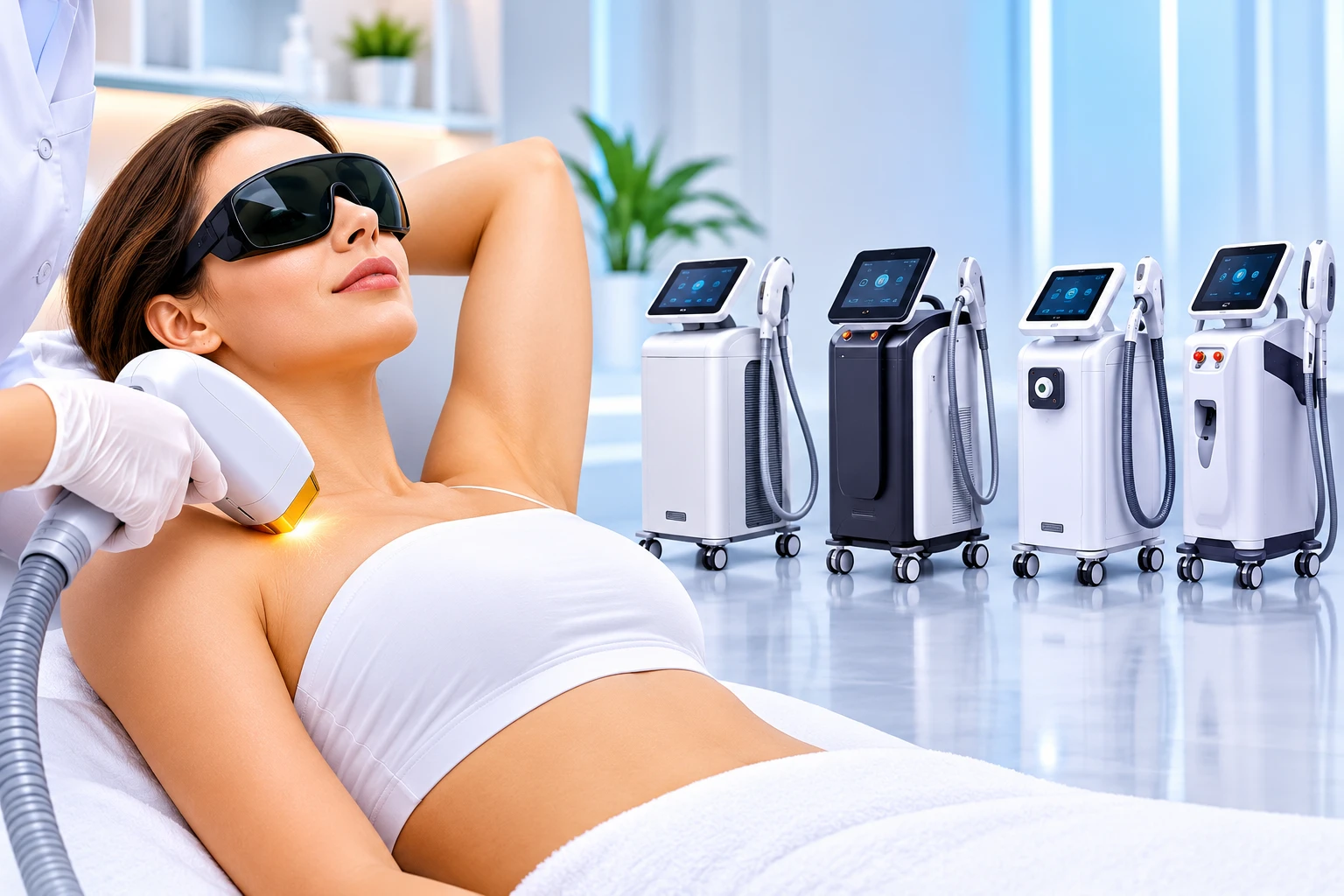
Laser Hair Removal Machine: A B2B Buyer’s Guide to Diode, Alexandrite, Nd:YAG, and IPL
Laser hair removal is one of the most requested services in aesthetics, which makes it one of the most competitive equipment categories to enter. Catalogs list diode, alexandrite, Nd:YAG, IPL, and combination systems with very similar claims, and many listings promise permanent results. For a clinic owner, distributor, or brand builder, the cost of choosing wrong shows up as unhappy clients, safety incidents, and wasted capital.
This guide is written for B2B buyers. It explains the main technologies, what the research shows, which specifications matter, how to think about safety and certification, and how to source and market laser equipment responsibly. Our laser hair removal category collects our related technical and sourcing guides.
What Is a Laser Hair Removal Machine?
A laser hair removal machine delivers pulses of concentrated light energy that are selectively absorbed by melanin pigment in the hair shaft and bulb. This optical energy converts to thermal heat, intentionally damaging the follicular stem cells and germinative matrix to inhibit future regrowth. Because the target chromophore is pigment, the laser beam interacts differently with various hair and skin colors—which is why correct wavelength selection is critical to clinical efficacy and safety.
The category also encompasses IPL (Intense Pulsed Light) devices, which discharge broad-spectrum, non-coherent light rather than a single laser wavelength. IPL is frequently marketed alongside true medical lasers in B2B catalogs and is sometimes colloquially described as ‘laser’ in promotional listings. B2B buyers must rigorously verify the actual underlying optical architecture in every supplier quote.
The Main Technologies Compared
Modern professional clinics rely on four core optical technologies, each engineered with distinct photothermal characteristics:
- Diode Laser (~800 to 810 nm): Diode systems operate at a balanced mid-range infrared wavelength. They offer an optimal compromise between high melanin absorption and deep tissue penetration, making them the most versatile, cost-effective workhorse in commercial clinics worldwide across Fitzpatrick skin types I through IV.
- Alexandrite Laser (755 nm): Alexandrite systems deliver high melanin absorption coefficients. They excel at clearing fine-to-coarse dark hair on lighter skin tones (Fitzpatrick I–III) and are renowned for high single-session clearance rates.
- Nd:YAG Laser (1064 nm): Nd:YAG delivers the longest wavelength in common aesthetic use. Because 1064nm bypasses competing epidermal melanin, it penetrates deeply into the dermis with minimal surface heating, making it the safest clinical choice for darker skin tones (Fitzpatrick IV–VI) and pseudofolliculitis barbae.
- IPL (Broad-spectrum 550–1200 nm): IPL emits filtered polychromatic light flashes. While machines are economical and versatile for generalized photo-rejuvenation, scientific evidence for long-term permanent hair reduction is markedly lower than targeted laser wavelengths.
- Combination and Multi-Wavelength Systems: Multi-wavelength platforms combine 755nm, 808nm, and 1064nm within a single handpiece or switchable consoles. They enable clinics to treat diverse demographic profiles, though they carry higher capital acquisition costs and require verified multi-bar laser diode engineering.
Comparison at a Glance
| Technology | Typical Wavelength | General Positioning | Main Buying Consideration |
|---|---|---|---|
| Diode Laser | ~800 to 810 nm | Versatile professional workhorse across Fitzpatrick I–IV | Active sapphire cooling, shot life (20M–50M), spot size |
| Alexandrite Laser | 755 nm | Lighter skin with fine to coarse dark hair (Types I–III) | High melanin peak absorption, cryo-cooling system, flashlamp life |
| Nd:YAG Laser | 1064 nm | Deepest penetration, gold standard for darker skin (Types IV–VI) | High pulse energy, epidermal sparing, patient comfort control |
| IPL (Intense Pulsed Light) | Broad band (550–1200 nm) | Lower-cost entry level; multi-purpose (hair + photofacial) | Optical cut-off filter quality, lamp replacement frequency, weaker long-term hair data |
| Multi-Wavelength Systems | Combined (755 + 808 + 1064 nm) | Broadest clinic coverage across all demographics in one console | Independent wavelength power distribution, dual/trio bar quality, certification validity |
What the Research Shows: Clinical Evidence & Efficacy Limits
Scientific literature strongly validates laser hair reduction, but with clearly defined boundaries. A landmark Cochrane systematic review evaluating lasers and intense pulsed light demonstrated an average short-term clearance of approximately 50 percent hair reduction with alexandrite and diode lasers up to six months post-treatment series. The review found limited robust long-term evidence for Nd:YAG or IPL, characterizing multi-year permanence as medically uncertain.
Furthermore, a comprehensive systematic review and meta-analysis examining hair removal in skin of colour (Fitzpatrick III–VI) concluded that while in-office lasers and IPL produced broadly comparable tolerability, clinical outcomes demonstrated a statistically superior trend toward greater, more durable clearance with true laser wavelengths over IPL devices.
Specifications That Matter: What to Request in Writing
When evaluating factory quotations or technical datasheets, never settle for marketing bullet points. Always demand certified technical parameters in writing:
- Wavelength & Energy Output: Demand the exact spectral wavelength tolerance (e.g., 808nm ± 5nm), maximum delivered fluence (J/cm²), adjustable pulse duration range (ms), and pulse repetition rate (Hz). Request third-party energy meter verification, as exaggerated peak power is rampant in entry-tier machinery.
- Cooling Architecture: Continuous epidermal contact cooling is the primary shield against superficial burns and treatment discomfort. Inquire about the cooling mechanism—such as active thermoelectric (TEC) cooling, integrated sapphire window contact chillers (-5°C to -10°C), and water-to-air radiator capacity during back-to-back hour-long clinic bookings.
- Handpiece Lifespan & Spot Dimensions: Spot size (e.g., 12x12mm vs. 15x25mm) dictates per-session treatment velocity. Simultaneously, verify the rated shot count per laser diode stack (typically 20 million to 50 million shots for premium microchannel bars) and the replacement cost per modular handpiece.
- Safety Interlocks & Thermal Sensors: Check for hardware emergency stops, flow rate sensors, internal coolant temperature alarms, and electrical interlocks. Patient safety circuitry should never be compromised for marginal price reductions.
- Embedded Software & Clinical Presets: Intuitive touchscreen interfaces with built-in Fitzpatrick phototype selectors, pulse-width modulation, user profile logging, and error diagnostic logs shorten operator training curves and prevent accidental over-treatment.
Safety, Clinical Training, and Regulatory Compliance
Operating high-energy Class 3B and Class 4 medical laser devices carries inherent clinical risks. Common benign reactions include transient perifollicular erythema and mild edema. However, incorrect fluence, inappropriate wavelength selection, or faulty cooling can cause severe complications, including thermal burns, blistering, post-inflammatory hyperpigmentation (PIH), hypopigmentation, and permanent scarring.
Optical Radiation Safety: Dedicated OD 5+ or OD 6+ laser safety protective goggles matching the exact operational wavelength are legally mandatory for both the practitioner and the client inside the treatment room.
Licensing & Statutory Supervision: Statutory regulations governing who may fire a medical laser vary widely across international jurisdictions. In certain territories, treatments require certified nurse practitioners or physician medical directors; in others, licensed aesthetic practitioners may practice under defined protocol supervision. Always audit regional public health codes before equipment commissioning.
Certification Due Diligence
Thoroughly audit conformity certificates: ensure the CE (Medical Device Regulation / MDR or LVD/EMC) or FDA 510(k) summary explicitly lists the exact manufacturing facility, model designation, and handpiece configuration you are procuring. Never borrow a third-party brand’s clearance number or accept unverified certificates from trading companies. Our comprehensive guide on why CE, FDA, and ISO certifications matter details how to verify documentation authenticity directly with accredited notified bodies.
Commercial Profiles & Financial Modeling (B2B Business Case)
Laser hair removal represents a core pillar of medical aesthetics because it drives predictable recurring footfall, high client retention, and attractive treatment cross-selling:
- Clinics & Medical Spas: Hair removal generates steady cash flow and acts as a gateway acquisition service. Top-performing clinics select diode or multi-wavelength consoles that match the demographic profile of their local clientele.
- Equipment Distributors: Regional distributors build tiered equipment catalogs—featuring entry, mid-range, and flagship medical platforms—to serve boutique salons, dermatology clinics, and franchised medspas. Providing rigorous clinical sales training ensures clients receive the right wavelength.
- Private Label & OEM Brand Builders: Because the category is mature, brand builders win through differentiated industrial design, premium user interfaces, documented energy outputs, robust cooling warranties, and superior after-sales customer service.
Landed Cost vs. Running Cost Calculation
When modeling equipment return on investment (ROI), factor in total landed costs rather than merely the initial FOB machine price:
- Total Landed Cost: Initial machine invoice + international freight & marine insurance + import tariffs & customs clearance + clinical operator certification.
- Consumables & Running Costs: Ultrasound transmission gel, hygienic protective barrier film, replacement deionized water filters, electricity, and handpiece shot amortization.
- Package Modeling: Laser hair removal is rarely sold as individual sessions. Package pricing (typically 6–8 sessions per anatomical zone) allows clinics to achieve full hardware payback within 3 to 6 months of steady appointment bookings.
Vetting B2B Manufacturers & Marketing Responsibly
To avoid costly equipment downtime, vet potential manufacturing partners thoroughly before wire-transferring funds:
- Factory Audits & Video Walkthroughs: Verify physical factory registration, cleanroom assembly standards for laser diode mounting, and automated aging tests (minimum 48-hour continuous firing verification).
- Component Provenance: Inquire about core component suppliers—such as German Dilas/Coherent diode bars, Italian fluid pumps, Japanese cooling fans, and medical-grade Mean Well power supplies.
- Warranty & Spare Parts: Insist on contractual warranty agreements (12 to 24 months minimum) covering the console and laser diode bars, with guaranteed dispatch timelines for modular replacement parts.
- Contractual Terms: Lock in written commitments for Minimum Order Quantities (MOQ), OEM logo printing, custom graphical user interfaces (GUI), and sea/air logistics terms. For deeper due diligence, review our guides on finding a reliable beauty equipment manufacturer and OEM vs. ODM manufacturing models.
Marketing Claims: Maintain Honesty & Regulatory Safety
- Position services as permanent hair reduction over a clinical protocol, never making unsubstantiated ‘guaranteed 100% hair removal’ claims.
- Always state clearly that anatomical results fluctuate according to hormonal profile, genetic hair density, skin phototype, and treatment compliance.
- Never claim clearance or study results belonging to recognized global brand names (e.g., Candela, Alma, Lumenis) for an OEM generic device.
5 Common Mistakes to Avoid When Buying Laser Equipment
- Promising Permanent Eradication: Overpromising complete hair destruction leads to client disputes, negative online reviews, and regulatory advertising sanctions.
- Purchasing an Incompatible Wavelength: Buying an Alexandrite laser for a clinic located in a predominantly dark-skinned demographic guarantees adverse burn incidents and unutilized capital.
- Trusting Exaggerated Spec Sheets: Unscrupulous vendors frequently market 300W laser handpieces as ‘2000W peak power’. Always request third-party optical bench calibration reports.
- Ignoring Consumable & Handpiece Amortization: A cheap machine with an expensive, fragile handpiece that requires frequent replacement will rapidly cost more than a premium medical system.
- Neglecting Clinical Training & Premises Compliance: Operating advanced Class 4 lasers without certified operator training and dedicated safety rooms invites severe liability risks.
Frequently Asked Questions (FAQ)
Expert answers to the most common questions regarding laser hair removal technology, clinical evidence, regulatory certification, and equipment sourcing.
What is the best laser hair removal machine for a clinic?
There is no single best machine. Diode systems are popular for versatility across skin types, alexandrite suits lighter skin with dark hair, Nd:YAG is generally safest for darker skin tones, and multi-wavelength systems cover a broader client mix. Choose based on your actual client demographics, treatment volume, and the verified engineering quality of the specific manufacturer.
Is laser hair removal permanent?
Clinical research supports significant long-term hair reduction, particularly with alexandrite and diode lasers, but complete permanent hair removal is not medically established. Professional clinics should ethically market treatments as ‘long-term hair reduction over a recommended series of sessions’ rather than making permanent removal guarantees.
What is the difference between laser and IPL?
True lasers emit a single, concentrated wavelength of coherent light (such as 755nm, 808nm, or 1064nm) specifically matched to melanin absorption at the follicle depth. IPL (Intense Pulsed Light) emits a broad spectrum of scattered, non-coherent light (typically 550nm to 1200nm). Peer-reviewed evidence shows lasers deliver higher efficacy and more reliable hair reduction compared to IPL.
What certifications should I check before purchasing?
Ensure regulatory certificates (CE, ISO 13485, and FDA 510(k) where applicable) explicitly cover the exact model, handpiece configuration, and wavelengths listed in your quote. Never accept certificates registered to third-party trading brands or borrowed clearances from other machines.
Do I need special training or a license to operate a laser hair removal machine?
Licensing and operator qualifications vary significantly by country, state, and municipality. Some regions require certified medical directors or esthetician licenses, while others require specific laser safety officer (LSO) credentials. Always verify local board rules before buying and invest in structured clinical staff training.
Can I get a laser hair removal machine customized for my brand (OEM/ODM)?
Yes. Reputable B2B manufacturers offer OEM and ODM customization, including exterior chassis color, private label logo placement, custom user interface (UI) software, packaging, and specific handpiece cooling configurations. Be sure to confirm the minimum order quantity (MOQ) and certification transferability.
What should I ask a supplier before placing an order?
Request written verification of: (1) exact wavelengths and peak power output, (2) cooling technology type and temperature stability during continuous firing, (3) rated handpiece shot lifespan and replacement cost, (4) valid regulatory certificates for that exact model, (5) warranty terms and availability of modular spare parts, and (6) MOQ and factory lead times.
Ready to Source Laser Hair Removal Equipment for Your Clinic or Brand?
Connect with our B2B engineering team for detailed technical datasheets, certified factory pricing, OEM/ODM customization options, and live virtual demonstrations.