How to Import Beauty Equipment from China: A Practical Guide for Clinics and Distributors
A distributor based in Toronto once described her first container shipment from China as “the most expensive lesson I never wanted to take.” She’d found a supplier on a B2B marketplace, wired a deposit, and assumed the rest would sort itself out. It didn’t. The devices arrived without the CE documentation she needed for her market, customs held the shipment for three weeks while she scrambled for paperwork, and by the time everything cleared, she’d missed the seasonal booking window she’d built her whole launch plan around.
Her story isn’t rare. China remains the manufacturing hub for the vast majority of the world’s professional beauty equipment, from HIFU and RF machines to laser systems and body contouring devices, and for good reason. The pricing advantage is real, the technology is often genuinely advanced, and the manufacturing capacity is unmatched. But the gap between placing an order and actually receiving usable, compliant equipment is wider than most first-time importers expect, and it’s paved with details that are easy to overlook until they cost you time or money.
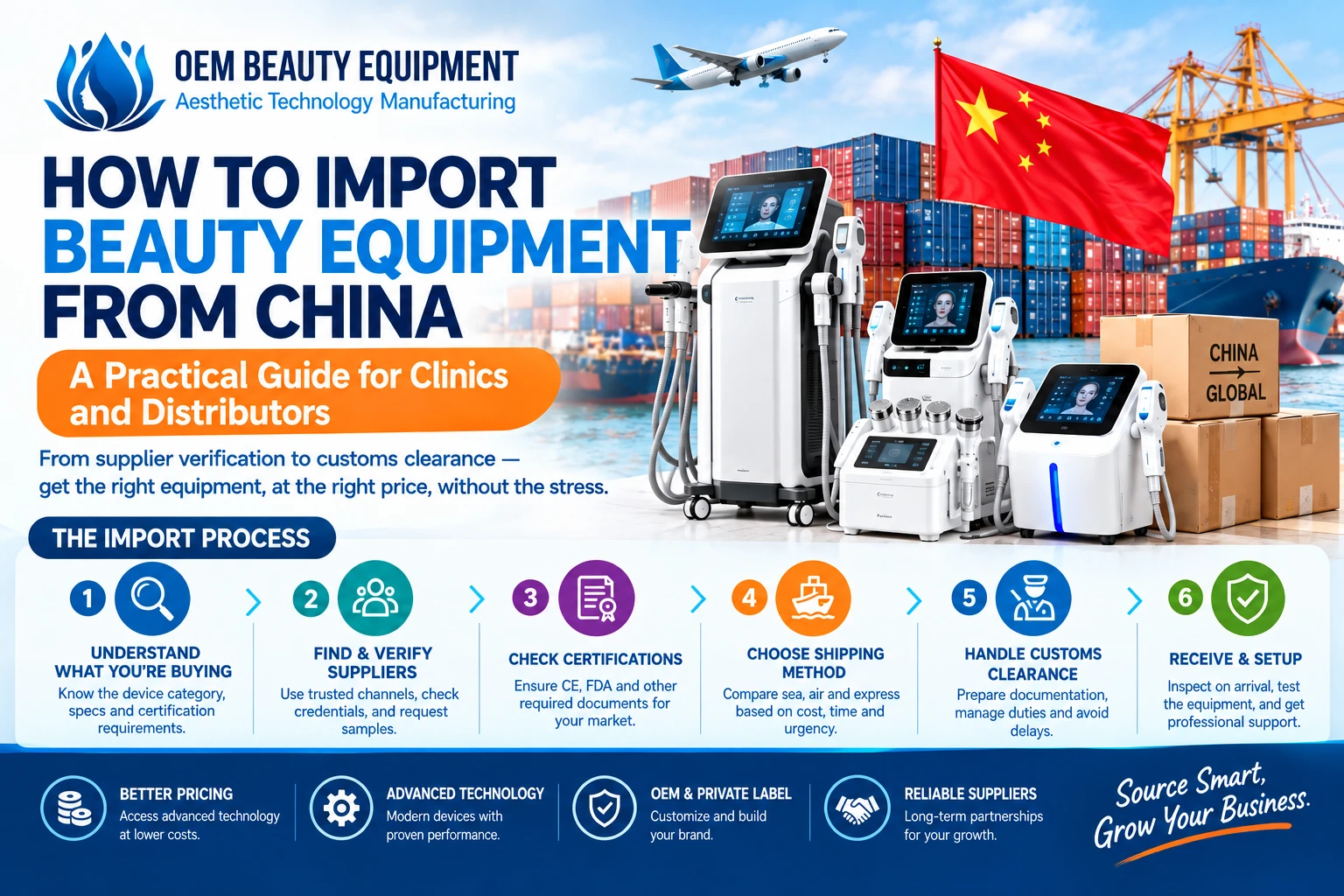
This guide walks through what clinics, distributors, and beauty brands actually need to know before importing beauty equipment from China, from supplier verification to certifications, shipping methods, and customs clearance.
Why So Many Buyers Source Beauty Equipment from China
Understanding the appeal helps explain why it’s worth doing properly rather than avoiding the process altogether.
China’s manufacturing ecosystem offers a genuine cost advantage, often allowing buyers to access advanced HIFU, RF, laser, and body contouring technology at a fraction of what the same specification would cost through a Western distributor reselling the same underlying hardware. Beyond pricing, many Chinese manufacturers invest heavily in research and development, meaning the technology itself is frequently on par with, or ahead of, equivalent devices sold at a premium elsewhere. Manufacturing scale also means shorter lead times for both initial orders and reorders once a relationship is established, along with far more flexibility for OEM and private label customization than most smaller regional suppliers can offer.
None of that removes the need for due diligence. It just means the reward for doing it properly is significant, and the cost of skipping it tends to show up later, usually at the worst possible time.
There’s also a shift worth noting for buyers weighing whether the reputation gap between Chinese manufacturing and Western manufacturing still holds true. Established factories in this sector increasingly invest in smart manufacturing systems, automated inspection technology, and production lines built to international quality standards, narrowing a gap that was once far more significant. That doesn’t mean every factory meets that standard, which is exactly why supplier verification matters as much as it does, but it does mean the blanket assumption that imported equipment is inherently lower quality is increasingly outdated when the sourcing is done properly.
Step One: Understand What You're Actually Buying
Before contacting a single supplier, get clear on the category of equipment you need. Aesthetic devices span a wide range, including skin care and hydrodermabrasion systems, laser and IPL hair removal machines, HIFU and RF skin tightening devices, EMS body sculpting platforms, and cryolipolysis or cooling-based body contouring equipment.
Each category carries different certification requirements, different shipping classifications, and different levels of regulatory scrutiny depending on your target market. Our guides on HIFU machines, RF machines, and laser hair removal machines cover the technical specifications worth understanding for each category before you start comparing supplier quotes, since a supplier’s price only makes sense once you know exactly what specification you’re comparing it against.
Step Two: Finding and Verifying a Reliable Supplier
This is the step most import problems trace back to, and it deserves more time than most first-time buyers give it.
Where to Find Suppliers
Common sourcing channels include B2B platforms like Alibaba, Made-in-China, and Global Sources, industry trade shows such as the Canton Fair in Guangzhou, and direct outreach to manufacturers with established export experience and English-speaking sales teams. Each channel has tradeoffs. Marketplace platforms offer volume and easy comparison but require more careful vetting, since listing quality varies enormously. Trade shows allow in-person evaluation of actual products but require travel and time. Direct manufacturer relationships, particularly with companies that already run OEM and ODM programs, tend to offer the most reliable long-term partnership once verified.
What to Verify Before Placing an Order
Ask for documented business qualifications and manufacturing licenses, not just a company name and a catalog. Request certification documentation directly, including CE, FDA registration, and ISO 13485, and verify those certificates rather than simply trusting a logo on a website. Ask specifically whether the company owns its own factory or is a trading company coordinating with third-party manufacturers, since accountability and quality control differ significantly between the two. Where possible, request sample units or a factory video tour before committing to a bulk order, and check for a documented track record with international clients similar to your business.
A supplier who answers these requests promptly and with real documentation is generally one worth working with. Hesitation, vague answers, or reluctance to share certificates is worth taking seriously as a warning sign, not something to overlook because the price looked good.
It’s also worth asking pointed questions about intellectual property protection if you’re planning any level of custom branding or design work. Registering your trademark in China before placing orders, and working with a manufacturer that has a documented track record of respecting client IP, protects you from a surprisingly common problem where a design commissioned for one client quietly reappears in another buyer’s catalog. This is a detail many first-time importers only think about after it’s already become a problem.
Step Three: Understand Certification Requirements for Your Target Market
Certification requirements vary meaningfully by region, and getting this wrong is one of the most expensive mistakes an importer can make, since equipment that clears customs but can’t legally be used clinically is essentially unusable.
For the United States market, confirm the device and manufacturer are properly registered through FDA’s device registration and listing process, and check whether the specific device category requires premarket clearance or qualifies under a lower-risk classification. For the European Union, compliance with the EU Medical Device Regulation, commonly referred to as MDR, along with proper CE marking, is essential before a device can be legally marketed or used clinically across EU member states. Beyond regional clearance, ISO 13485 certification confirms the manufacturer follows a documented, auditable quality management system, which is worth confirming regardless of which specific regional certifications apply to your market.
Requirements outside the US and EU vary considerably, so it’s worth consulting your own country’s import and medical device authority directly, or working with a licensed customs broker familiar with aesthetic equipment specifically, rather than assuming a certification valid in one region automatically satisfies another.
Step Four: Choosing the Right Shipping Method
How you ship affects both cost and timeline significantly, and the right choice depends on order size, budget, and how quickly you need the equipment operational.
| Shipping Method | Typical Transit Time | Best For |
|---|---|---|
| Sea Freight | 25 to 45 days | Bulk orders, lower cost priority |
| Air Freight | 5 to 10 days | Smaller orders, faster turnaround needed |
| Express Courier | 3 to 7 days | Samples, small urgent shipments |
Sea freight remains the most cost-effective option for bulk shipments, though the longer transit time means it needs to be factored into your launch or restocking timeline well in advance. Air freight costs considerably more per unit but makes sense for smaller orders or situations where a delay would cost more than the shipping premium. Express courier services work well for sample units or urgent small shipments but become impractical at any real volume due to cost.
Step Five: Navigating Customs Clearance
Customs clearance is where a well-prepared import goes smoothly and a poorly prepared one gets stuck for weeks.
Prepare complete documentation in advance, including a detailed commercial invoice, accurate product specifications, proper labeling, and any required import permits for medical-grade devices, since most aesthetic equipment above a basic consumer classification requires this level of documentation regardless of destination country. Confirm in advance whether your specific device category requires a formal import permit or license, since medical-grade equipment frequently does even in markets with otherwise straightforward customs processes.
Working with a licensed customs broker experienced specifically in medical or aesthetic equipment is worth the cost for anything beyond a small sample order, since brokers familiar with this category understand the documentation customs officials expect and can flag missing paperwork before it causes a hold at the border rather than after.
Payment structure also deserves attention as part of this stage of the process. Bank transfer, commonly referred to as T/T, is the most common payment method for standard orders, typically split between a deposit before production and the balance before or upon shipment. For larger orders, a letter of credit can provide additional protection for both parties, since it ties payment release directly to documented proof of shipment. Whichever method you use, avoid paying the full amount upfront regardless of how established the supplier appears, since retaining leverage until goods are confirmed shipped protects you if something goes wrong mid-production.
Common Mistakes When Importing Beauty Equipment from China
Most costly import problems trace back to a handful of avoidable decisions.
Choosing a supplier based purely on the lowest quoted price, without verifying certifications or manufacturing credibility, tends to be the most expensive mistake in the long run, since the savings rarely account for compliance issues or poor after-sales support down the line. Skipping certification verification is a close second, particularly assuming a device is compliant simply because a listing mentions CE or FDA without requesting the actual documentation. Underestimating realistic shipping timelines, especially for sea freight, creates real business problems when equipment doesn’t arrive in time for a planned launch or seasonal promotion. Failing to clarify intellectual property protections when commissioning custom or OEM designs can create ownership disputes later, particularly for brands investing in unique branding or design work. And overlooking after-sales support entirely, assuming a low purchase price means the relationship ends at delivery, leaves clinics and distributors without recourse when technical issues or spare parts needs inevitably arise.
A final mistake worth naming directly is treating the first successful shipment as proof the relationship is fully vetted. A supplier can deliver a strong first order and still struggle with consistency on a second or third, whether due to component sourcing changes, staff turnover, or simply taking on more clients than their quality control process can reliably support. Staying in regular contact and requesting updated documentation periodically, rather than assuming the relationship runs on autopilot after the first successful delivery, protects against quality drift over time.
Why Working Directly with an OEM Manufacturer Simplifies the Process
Much of the complexity described above gets significantly easier when you work directly with an established OEM beauty equipment manufacturer rather than an unverified trading company or marketplace listing with no manufacturing accountability.
A manufacturer with its own production facility, documented quality control, and export experience typically handles certification documentation, export paperwork, and shipping coordination as a standard part of the relationship, rather than leaving the buyer to assemble compliance requirements independently. This is particularly valuable for businesses pursuing OEM or private label products, since a manufacturer experienced in international distribution has usually already navigated the certification requirements for multiple regions on behalf of other clients, which saves considerable time compared to a first-time export relationship. Our manufacturing capabilities and certification page outline exactly this kind of support for buyers evaluating a direct manufacturing partnership.
Frequently Asked Questions About Importing Beauty Equipment from China
Is it legal to import beauty equipment from China?
Yes, provided the equipment meets the certification and regulatory requirements of your destination market, such as FDA registration in the United States or CE marking and MDR compliance in the European Union. Legality depends on compliance, not the country of manufacture.
How long does it take to import beauty equipment from China?
Sea freight typically takes 25 to 45 days, air freight 5 to 10 days, and express courier 3 to 7 days, though customs clearance timing on top of transit time varies by destination country and documentation completeness.
What certifications should I check before importing?
At minimum, verify CE certification for the European market, FDA registration for the U.S. market, and ISO 13485 certification confirming the manufacturer’s quality management system, along with any additional requirements specific to your destination country.
Can I get custom branding on equipment imported from China?
Yes. Many manufacturers, particularly those offering OEM and ODM services, can customize branding, housing design, packaging, and in some cases software, allowing distributors and beauty brands to launch a private-labeled product rather than reselling generic equipment.
What is the difference between working with a trading company and a manufacturer directly?
A trading company acts as an intermediary and may not have direct oversight of production, while working with a manufacturer that owns its own facility generally provides more accountability, better quality control, and more reliable after-sales support.
Do I need a customs broker to import beauty equipment?
For anything beyond a small sample order, working with a licensed customs broker experienced in medical or aesthetic equipment is strongly recommended, since they understand the documentation requirements specific to this equipment category and can help avoid clearance delays.
Final Thoughts
Importing beauty equipment from China can be a genuinely smart business decision when it’s handled with the same diligence you’d apply to any significant capital purchase. Verify your supplier thoroughly, confirm certifications with actual documentation rather than assumptions, plan realistic shipping timelines, and prepare customs paperwork in advance rather than scrambling after a shipment is already in transit.
Working with an experienced OEM manufacturer who already handles certification, export documentation, and after-sales support as part of the relationship removes much of the risk described in this guide. If you’re exploring a first import or planning an OEM private label project, our team can walk through the process, timeline, and requirements specific to your target market. Contact us to get started, or explore our full OEM and ODM manufacturing capabilities to see what’s possible.