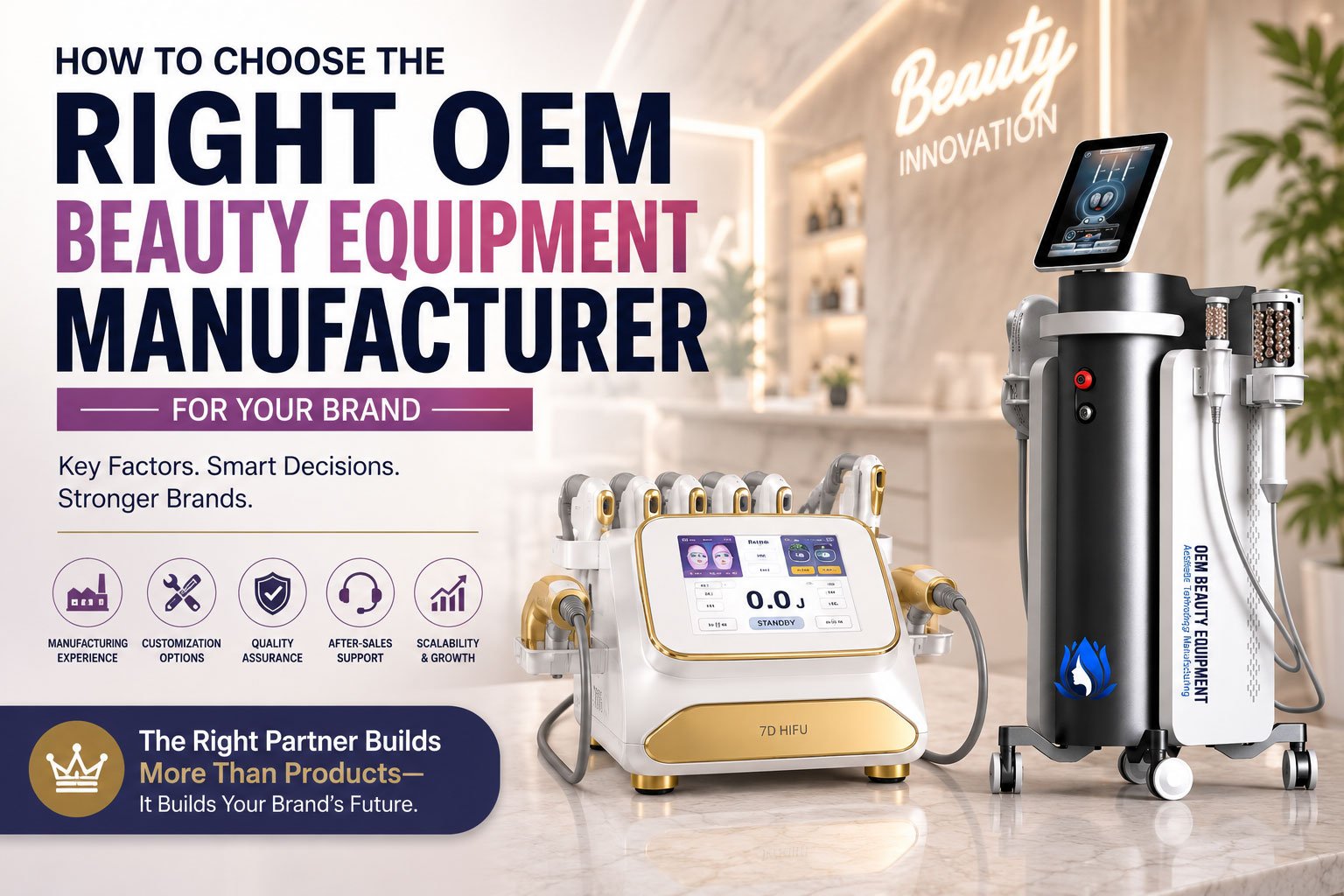
How to Choose the Right OEM Beauty Equipment Manufacturer for Your Brand
A friend of mine who runs a growing skincare brand once described her first attempt at launching a device line as “ordering from a catalog and hoping for the best.” She picked a manufacturer based on the lowest quote in her inbox, signed a deposit, and waited. Six weeks later the sample arrived with the wrong logo placement, a housing color that didn’t match the approved mockup, and instructions written in barely translated English. She had to start over with a different factory, and the delay cost her a full retail season.
That story isn’t unusual. Choosing a manufacturer is a very different decision from choosing a product. When you buy a single piece of equipment, you’re evaluating a spec sheet. When you’re building a branded beauty equipment line, you’re evaluating a long-term working relationship, one that will shape your product quality, your delivery timelines, and ultimately how your customers perceive your brand.
This guide walks through what brands should actually look for before committing to an OEM partner, from factory capabilities and customization depth to the quality control processes that separate a dependable manufacturer from a risky one.
What Is an OEM Beauty Equipment Manufacturer?
OEM stands for Original Equipment Manufacturing. In the beauty equipment space, an OEM beauty equipment manufacturer builds devices, often based on an existing proven platform, that get customized and sold under a different company’s brand name. The broader concept of OEM manufacturing has existed across industries for decades, and Wikipedia’s overview of original equipment manufacturing explains the general principle well: one company makes the product, another company sells it under its own identity.
In practice, an OEM beauty equipment manufacturer typically operates its own production facility, handles component sourcing, and offers a menu of customization options ranging from simple logo changes to more involved housing and interface modifications. Brands come to these manufacturers because building an in-house factory from scratch is slow, expensive, and usually unnecessary when a capable manufacturing partner already exists.
Private-label and customized equipment sit at the center of this relationship. A private-label arrangement means the device ships with your branding and no visible trace of the original manufacturer. Customized equipment goes a step further, adjusting design elements to fit your brand’s aesthetic or your target market’s specific needs. Working with an established OEM beauty equipment manufacturer usually means you get both options on the table rather than being locked into one.
Why Work With an OEM Beauty Equipment Manufacturer?
The appeal isn’t just cost. It’s what that cost actually buys you.
Build Your Own Beauty Equipment Brand
Rather than reselling someone else’s name, OEM manufacturing lets you put your own brand on the device, the packaging, and every piece of marketing material that follows. Over time, that builds equity you actually own instead of equity you’re renting.
Customize Products for Your Market
Different regions and different patient bases respond to different things. A manufacturer capable of real customization lets you adjust a product for local preferences, whether that’s a housing color that fits a particular market’s aesthetic or interface language localized for your customer base.
Reduce Product Development Costs
Designing custom beauty equipment from a blank sheet of paper is expensive. Working from an established OEM platform means the core engineering work is already done, which significantly lowers your development cost compared to building from zero.
Scale Your Product Line
Once the relationship is working well, expanding your line, adding new devices, or entering new categories becomes far faster than it would be if you had to vet an entirely new supplier for every product. A manufacturer with broad professional beauty equipment capabilities can grow alongside your catalog.
What to Look for in a Beauty Equipment Manufacturer
This is the section that actually matters most, so it’s worth slowing down here.
Manufacturing Experience
A beauty equipment manufacturer with a decade or more in the industry has usually already worked through the production mistakes newer factories are still making in real time, often at their customer’s expense. Ask how long they’ve been producing devices specifically in the category you’re interested in, not just beauty products broadly.
Product Development Capabilities
Does the manufacturer have an actual engineering and R&D team, or are they simply reselling designs licensed from somewhere else? A manufacturer with genuine development capability can troubleshoot issues, suggest improvements, and adapt designs in ways a pure reseller cannot.
Customization Options
Ask specifically what can be changed, not just whether customization is “available.” Vague answers here are usually a sign that customization is more limited than the sales pitch suggests.
Quality Control Process
Every reputable beauty equipment manufacturer should be able to describe their quality control process in specific, concrete terms, including what gets tested, at what stage, and by whom. A manufacturer certified under ISO 9001, the internationally recognized standard for quality management systems, has documented processes that can be audited rather than taken on faith.
Production Capacity
Confirm the manufacturer can actually handle your order volume, both for your initial order and for the reorders that follow if your product sells well. A factory that struggles at scale is a problem you don’t want to discover after your product has launched.
It helps to ask for a straightforward answer on current monthly output for the specific product category you’re ordering, rather than a general factory-wide figure that might be spread across dozens of unrelated product lines. A manufacturer juggling too many clients on limited capacity will eventually start pushing your reorder to the back of the queue, usually right when you need it most.
Does the Manufacturer Have Its Own Beauty Equipment Factory?
This question sounds basic, but it trips up more buyers than you’d expect. Some companies presenting themselves as manufacturers are actually trading companies or intermediaries working with third-party factories they don’t control.
Why does this matter? Because a manufacturer with its own beauty equipment factory has direct oversight of production equipment, R&D capabilities, and quality control, rather than depending on a chain of subcontractors where accountability gets murky the moment something goes wrong. Direct factory ownership also generally means better production capacity planning, since the manufacturer isn’t competing with other clients for a third party’s limited manufacturing slots.
When evaluating a potential partner, ask for photos or a video tour of the actual production floor, ask which specific processes happen in-house versus outsourced, and ask how OEM customization requests get implemented on the production line. A manufacturer with nothing to hide will usually welcome these questions rather than deflect them. Our own manufacturing capabilities page outlines exactly this kind of detail, since we believe buyers should see what they’re actually working with before committing.
How Much Customization Can OEM Beauty Equipment Offer?
Customization depth varies enormously between manufacturers, and it’s worth understanding the full range before assuming a supplier’s basic package covers what you need.
Product Design
Beyond surface branding, some manufacturers can adjust internal layout, control panel positioning, and overall device ergonomics to better fit your product vision.
Branding and Logo
The most basic level of customization, but still worth confirming details like logo placement, engraving versus printing, and how logos appear across accessories and packaging, not just the main unit.
Colors and Materials
Housing color, material finish, and texture all affect how a device photographs and how it feels in a clinician’s hands. Confirm what color and material options exist, and whether custom colors require a minimum order quantity.
Software and User Interface
More advanced manufacturers can adjust the on-screen interface, language options, and even treatment protocol presets to match your brand’s clinical positioning.
Packaging and Accessories
Retail and clinical packaging, included accessories, and instruction manuals all carry your brand once customized properly. This is often overlooked until a customer opens the box and finds generic, unbranded packaging inside a branded shipping carton.
OEM Beauty Equipment Quality Control
Quality control is where good manufacturers and risky ones become obvious, if you know what to ask.
Product Testing
Ask what testing happens before a device ships, including functional testing, safety testing, and stress testing under realistic clinical use conditions.
Component Quality
Cheaper components are the single easiest place for a manufacturer to cut costs invisibly. Ask specifically about sourcing for key components like transducers, control boards, and power supplies, and whether those components come with their own certifications.
Manufacturing Standards
A manufacturer operating under recognized standards, such as ISO 9001 quality management requirements, has documented processes for consistency across production runs, not just a one-time quality check on a sample unit.
Final Product Inspection
Confirm whether every unit gets inspected before shipping or whether inspection happens on a sampling basis. For professional beauty equipment going into clinical settings, full inspection is generally the safer standard to insist on.
It’s also worth asking whether inspection reports are shared with you as the buyer, or whether they simply stay in the factory’s internal records. Manufacturers confident in their process are usually happy to provide inspection documentation alongside each shipment, which gives you a paper trail if a warranty claim or a batch issue ever comes up later.
What Services Should an OEM Beauty Equipment Supplier Provide?
A genuine beauty equipment supplier offers more than just a product catalog. The services wrapped around that product often matter more over the life of the relationship.
Look for a supplier that provides real product customization rather than a fixed menu with no flexibility. Technical support should be available in a format that actually works for your timezone and language needs, not just an email address that takes a week to respond. Product development support matters if you plan to expand your line over time, since a supplier who can only replicate existing designs limits your growth. Packaging and shipping logistics should be handled competently enough that you’re not troubleshooting customs issues on your own. After-sales support, replacement parts availability, and training materials for your own staff or end customers round out what a complete OEM relationship should include. A supplier missing several of these is really just a factory with a sales team, not a long-term manufacturing partner.
OEM vs Buying Ready-Made Beauty Equipment
For brands still deciding whether OEM is even the right path, here’s a quick comparison.
| OEM Equipment | Ready-Made Equipment |
|---|---|
| Brand customization | Limited customization |
| Custom specifications | Standard specifications |
| Private branding | Manufacturer branding |
| Better for established brands | Better for simple purchasing |
If you’re a clinic simply purchasing equipment to use in-house, ready-made devices are usually the faster, simpler route. If you’re building a brand you intend to sell under your own name, OEM is generally the only path that makes sense long term.
Questions to Ask an Aesthetic Equipment Manufacturer
Before signing anything, get direct answers to these:
- Do you offer OEM customization, and to what extent?
- What products can be customized, specifically?
- What is the minimum order quantity?
- What is the production lead time from deposit to delivery?
- What testing is performed on units before shipping?
- What technical support is available after purchase?
- Can you provide private-label packaging, and what does that include?
- What after-sales support is included in the agreement?
A manufacturer who answers these clearly, with specific numbers rather than vague reassurances, is generally one worth trusting with a deposit.
How to Select the Best OEM Partner for Your Beauty Brand
Once you’ve gathered answers, weigh them against this checklist:
- Manufacturing capability and in-house production
- Product quality and component sourcing
- Depth of customization actually available
- Technology and R&D capabilities
- Production capacity for both launch and reorder volume
- Communication responsiveness and clarity
- Realistic lead time from order to delivery
- After-sales support structure
- Pricing transparency, not just the lowest quote
- Willingness to build a long-term partnership rather than a one-time transaction
The last point matters more than buyers usually expect going in. The cheapest first order rarely stays cheap once you factor in the cost of switching manufacturers when the relationship doesn’t work out.
Why Choose OEM Beauty Equipment From OEM Beauty Equipment
Our approach centers on giving beauty brands genuine control over the equipment they sell, not just a logo swapped onto an existing shell. That means real OEM manufacturing built around your specifications, meaningful product customization across design, color, and interface, and professional beauty equipment built on platforms with documented R&D and manufacturing capabilities behind them.
Branding and packaging are handled as part of the process rather than an afterthought, and our B2B support structure is built for brands planning to grow a catalog over time, not just place a single order. You can review our full range of capabilities on our OEM and ODM services page or learn more about our background on our about us page.
If you’re ready to talk specifics, request a quote and contact our team to discuss your product requirements, timeline, and customization needs.
Frequently Asked Questions About OEM Beauty Equipment
What is OEM beauty equipment?
OEM beauty equipment refers to aesthetic devices manufactured by one company and sold under another company’s brand name, typically customized with the buyer’s logo, design preferences, and packaging.
What does an OEM beauty equipment manufacturer do?
An OEM beauty equipment manufacturer designs, produces, and customizes aesthetic devices for other brands to sell, handling everything from component sourcing and assembly to branding and packaging based on the client’s specifications.
How do I choose a beauty equipment manufacturer?
Evaluate manufacturing experience, in-house factory capability, customization depth, documented quality control processes, production capacity, and after-sales support before committing. Ask for specific answers rather than general assurances.
Can OEM beauty equipment be customized?
Yes. Customization typically ranges from basic logo and branding changes to deeper modifications including housing design, color, materials, software interface, and packaging, depending on the manufacturer’s capabilities.
What is the difference between an OEM supplier and a beauty equipment factory?
A beauty equipment factory owns and operates its own production facility, while an OEM supplier may or may not manufacture in-house and could be coordinating with third-party factories. Working directly with a manufacturer that owns its factory generally provides more oversight and accountability.
What should I ask an aesthetic equipment manufacturer before ordering?
Ask about customization options, minimum order quantities, production lead times, testing procedures, technical support, private-label packaging availability, and after-sales support before placing an order.
Can a beauty equipment manufacturer provide private-label products?
Most established OEM manufacturers offer private-label services, meaning the device and packaging carry your brand exclusively with no visible reference to the original manufacturer.
What types of professional beauty equipment can be customized?
Common categories include HIFU, RF, laser, and multi-functional aesthetic platforms, with customization typically covering housing design, branding, interface, and included accessories, depending on the manufacturer’s engineering capabilities.