
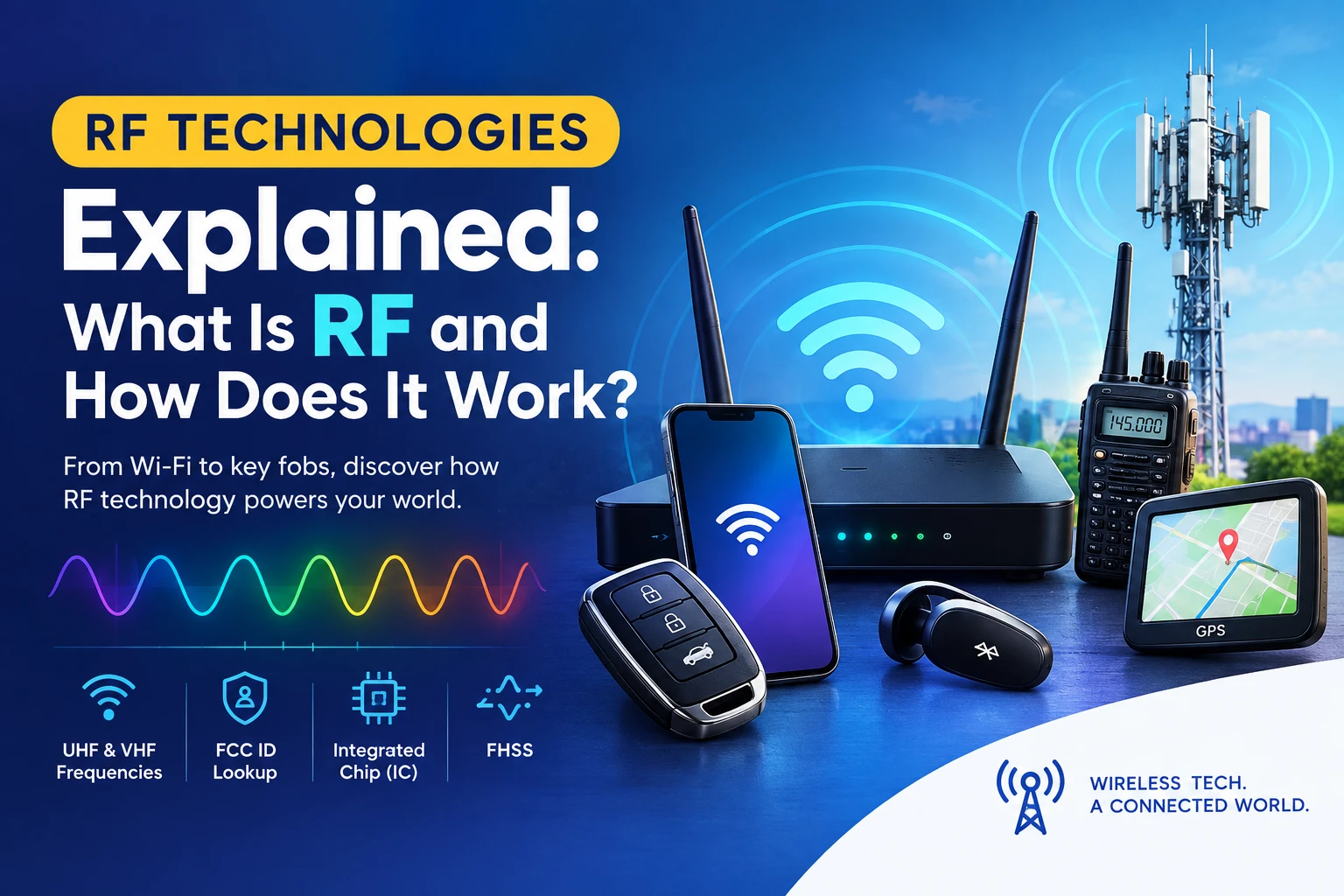
RF Technologies Explained: What Is RF and How Does It Work?
From the Wi-Fi router in your living room to the key fob that unlocks your car, radio frequency technology quietly powers an enormous share of the devices we use every day. Yet most people who rely on it couldn’t explain what “RF” actually means. This guide breaks down what RF technology is, how it works, and the key concepts worth understanding, whether you’re a hobbyist, an engineer, or simply curious.
[Internal link opportunity: link “RF technology” above to your homepage or main RF category page]
What Is RF (Radio Frequency)?
RF, short for radio frequency, refers to electromagnetic waves used to transmit information wirelessly. These waves fall within a specific range of the electromagnetic spectrum, and they carry signals through the air without the need for physical cables. For a formal technical reference, the NASA Science overview of the electromagnetic spectrum explains where radio waves sit relative to other wave types.
RF technology underpins wireless communication of nearly every kind, including radio broadcasting, television, mobile networks, Wi-Fi, Bluetooth, GPS, and countless industrial and medical applications.
How RF Technology Works
At its core, RF technology works by converting information, such as sound, data, or video, into an electromagnetic wave, transmitting that wave through the air, and converting it back into usable information at the receiving end.
The Basic RF Communication Process
- Signal generation: An electronic circuit generates a radio wave at a specific frequency.
- Modulation: Information is encoded onto the wave by varying its amplitude, frequency, or phase.
- Transmission: The modulated signal is sent out through an antenna.
- Reception: A receiving antenna picks up the signal.
- Demodulation: The receiver extracts the original information from the wave.
[Internal link opportunity: if you have a “how wireless devices work” or product-specific explainer page, link it here]
Understanding Radio Frequency Bands
Different frequency ranges, or “bands,” are allocated for different uses, partly to prevent interference between devices and services. The FCC’s Spectrum Dashboard shows how the U.S. allocates frequency bands across services.
UHF (Ultra High Frequency)
UHF frequency covers the range from 300 MHz to 3 GHz, widely used for television broadcasting, Wi-Fi, Bluetooth, GPS, and two-way radios. UHF signals generally mean shorter range but better penetration through buildings and obstacles.
VHF (Very High Frequency)
VHF sits just below UHF, typically used for FM radio, marine communication, and some aviation systems.
Amateur Radio Frequencies and Ham Radio Bands
Amateur radio, commonly known as ham radio, operates across multiple designated frequency bands. These are regulated in the U.S. by the FCC, and the American Radio Relay League (ARRL) band plan provides a detailed, hobbyist-maintained reference for current allocations. Transmitting on these bands typically requires passing an exam and obtaining a license.
[Internal link opportunity: link to your own ham radio or amateur equipment product category, if applicable]
FCC IDs: What They Are and Why They Matter
In the United States, any device that intentionally or unintentionally emits radio frequency energy generally needs approval from the Federal Communications Commission (FCC) before it can be sold. This approval is represented by an FCC ID, a unique identifier assigned to the specific device and its manufacturer.
How to Do an FCC ID Lookup
You can search any device’s FCC ID directly through the FCC’s official Equipment Authorization Search. An FCC ID lookup typically reveals:
- The manufacturer and device name
- The frequency bands the device operates on
- Test reports confirming it meets safety and interference standards
- Internal and external photos of the device, in many cases
The FCC ID is usually printed on a label on the device itself, often on the back or underside, or found within its settings menu for electronic displays.
[Internal link opportunity: if you sell or test RF devices, link to your product certification or compliance page here]
The Hardware Behind RF: Integrated Chips and IC Chips
Modern RF devices rely on specialized integrated chips (ICs) to generate, process, and manage radio signals efficiently. An RF integrated chip combines multiple components, such as amplifiers, filters, and oscillators, onto a single piece of silicon, dramatically reducing the size and cost of RF circuits compared to older designs built from discrete components.
[Internal link opportunity: link to your IC chip or components product page, if you sell these]
What Is FHSS (Frequency-Hopping Spread Spectrum)?
FHSS is a transmission method where a signal rapidly switches, or “hops,” between many different frequencies according to a predetermined pattern known to both the transmitter and receiver. This offers resistance to interference, improved security, and reduced congestion. FHSS is commonly used in technologies like Bluetooth and some cordless phones.
Common Applications of RF Technology
- Wireless networking: Wi-Fi, Bluetooth, cellular networks
- Broadcasting: AM/FM radio, television
- Navigation: GPS satellite signals
- Security and access: Key fobs, RFID tags, garage door openers
- Medical devices: Wireless patient monitors, certain implantable devices
- Industrial use: Remote sensors, RF-based inventory tracking
- Amateur and emergency communication: Ham radio operators, emergency responder networks
[Internal link opportunity: link each application to a relevant product category if you carry them]
Frequently Asked Questions
What is RF in simple terms?
RF, or radio frequency, refers to electromagnetic waves used to wirelessly transmit information, powering technologies like Wi-Fi, Bluetooth, radio, and television broadcasting.
What is the difference between UHF and VHF?
UHF covers higher frequencies (300 MHz–3 GHz) and is used for things like Wi-Fi and TV broadcasting, while VHF covers lower frequencies and is commonly used for FM radio and marine communication.
How do I look up an FCC ID?
You can search an FCC ID directly through the FCC’s Equipment Authorization Search to find the device’s manufacturer, frequency specifications, and test reports.
Do I need a license to use amateur radio frequencies?
In most countries, yes. In the U.S., this requires passing an FCC exam. The ARRL offers licensing resources and study guides for prospective operators.
What does FHSS stand for?
FHSS stands for frequency-hopping spread spectrum, a transmission technique where a signal rapidly switches between multiple frequencies to resist interference and improve security.
Conclusion
RF technology is one of those invisible forces that shapes daily life far more than most people realize. Whether you’re curious about how your Wi-Fi router works, looking up an FCC ID, or exploring amateur radio as a hobby, understanding the basics of RF gives you a clearer picture of the technology running quietly in the background of modern life.